Bible


thoughts-greaterThe prophet Isaiah records YHWH as saying:

For my thoughts are not your thoughts, neither are your ways my ways, declares the Lord. 9 For as the heavens are higher than the earth,  so are my ways higher than your ways and my thoughts than your thoughts. (Is 55:8-9)

This verse is quoted to make a variety of points.  Some quote it to make the point that God is unknowable.  Others use it to argue that we can’t understand God’s will and way of thinking.  My favorite use of this verse, however, is in a debate when someone’s position is being challenged and they don’t know how to respond.  When all else fails, just claim that your point of view is too lofty to understand because it comes directly from God!

(more…)

lifted-upHow many times have you heard the worship leader say something like, “Jesus said ‘If I be lifted up I will draw all men to me,’ so let’s worship Jesus and allow him to draw us nearer”?  Sometimes it is implied that our worship of Jesus will even result in Jesus bringing sinners to salvation.

A simple reading of the context reveals that it is being both misquoted and taken out of context.  Jesus didn’t say “If I be lifted up I will draw all men to me,” but rather “If I be lifted up from the earth, I will draw all men to me.”  The addition of the bolded words alone make it clear that the worship leader’s interpretation is wrong.  The context makes it even more obvious: (more…)

straight-outta-contextEveryone wants to be understood properly – even God.  In communication, a proper understanding can only be achieved when a clear message is properly interpreted.  If the sender does not clearly convey his message, or if the receiver does not properly interpret the sender’s message, miscommunication and misunderstanding results.  This happens all the time with the Bible.  We often misunderstand it because we fail to interpret God’s words properly.

Interpreting the Bible is more difficult than interpreting a modern text or conversation because it reflects a different era, geography, language, worldview, culture, literary genres, and idioms.  Oddly enough, the vast majority of Christians are never trained in Biblical interpretation.  Given this circumstance, it’s no wonder the Bible is misinterpreted and misapplied so much.

(more…)

Two new books have been published reporting on the discovery of 25 Hebrew Bible texts, at least some of which may be part of the Dead Sea Scrolls.  There have been ~70 such texts that have appeared on the antiquities market since 2002.

The provenance of these manuscripts is uncertain since they were found on the antiquities market, but they may have come from the Qumran caves. They are believed to be ~2000 years old.

Nehemiah was the only book that was not found among the original Dead Sea Scrolls. This new cache of manuscripts, however, contains portions of Nehemiah (2:13-16), as well as Genesis, Exodus, Leviticus, Deuteronomy, Samuel, Ruth, Kings, Micah, Nehemiah, Jeremiah, Joel, Joshua, Judges, Proverbs, Numbers, Psalms, Ezekiel, and Jonah. Given the unknown provenance, however, the manuscript may not be part of the Dead Sea Scrolls, even if it dates from the same period of time.

Work is currently underway to investigate the manuscripts to make sure they are not forgeries.

News articles:

Live Science

History


Update 3/16/20: The Museum of the Bible held 16 of these ~70 post 2002 fragments. They were recently discovered to be forgeries, casting doubt on the other ~55 as well. See the National Geographic’s “Exclusive: ‘Dead Sea Scrolls’ at the Museum of the Bible are all forgeries

Story of ChristianityMuch of the Bible is written in narrative form.  It tells a story – a true story, but a story nonetheless.  There is a lot of information in the Bible to digest, and it’s easy to get lost in the details and miss the big picture.  So how does one put it all together?  What is the essence of the Biblical story?  What is the basic story line from Genesis to Revelation?  Various attempts have been to condense the major themes and events in the Bible into a coherent, terse story line.  Here is my attempt to arrange the puzzle pieces into a clear picture, such as it is.  I hope it will tie together some loose ends that may exist in your mind and offer you a bird’s-eye view of the greatest story ever told: (more…)

This past week has brought to the public’s attention the discovery of two important manuscripts: one of Leviticus and one of the Qur’an.

Leviticus

The Leviticus manuscript was actually discovered in 1970 in a Torah ark from a Byzantine-era synagogue excavated at Ein Gedi in Israel. It was burnt by a fire, however, and could not be deciphered until now. The scroll was found to contain Leviticus 1:1-8. It is dated no later than the 6th century A.D. (when the synagogue and village were burned).

Burnt Leviticus scroll 1

Burnt Leviticus scroll 2


Qur’an

Two pages of the Qur’an (portions of Surahs 18-20) were discovered inside the codex of another late 7th century Qur’anic manuscript at Birmingham University.  Radiocarbon dating of the manuscript has revealed an age of A.D 568A- 645.  Muhammad lived from A.D. 570 – 632, making it a live possibility that the manuscript fragment was composed while Muhammad was still alive.

(more…)

Here is a great video summarizing the homily to the Hebrews.

http://www.youtube.com/watch?v=z9wqN-nwSzE

We rightfully bemoan the rise of the gay hermeneutic in which Christians are reinterpreting the Bible to allow for committed same-sex relationships, but has anyone ever stopped to think that what these liberals are doing to the homosex texts we “conservatives” have already done to the divorce and remarriage texts?  We have mangled Jesus and Paul’s teachings to allow for divorce for reasons other than sexual immorality, and to allow those who have divorced or have been divorced without grounds to remarry because we don’t think it is fair for people to be unhappy or alone.  We understand the strong desire to be in a loving, sexual relationship.  Our emotions become the motivating factor for reinterpreting (or ignoring) what would otherwise seem to be a pretty straightforward condemnations for most divorces and remarriages.

(more…)

That’s an easy answer: p52 (a fragment of John 18).  Perhaps not.  P52 is typically dated to A.D. 125-175. There is a fragment of Matthew 21, p104, that is dated to A.D. 100-200.  The mean age of both manuscripts is A.D. 150, but if p104 is as early as its terminus a quo, then p104 may be the earliest NT manuscript.

P52

P52


P104

P104

Of course, there is still the possibility that we have a fragment of Mark’s gospel dated to before A.D. 90. The court is still out on this one since the research on this fragment has yet to be published. If it turns out to be a valid date, it would be the first NT fragment from the first century to be discovered – an exciting prospect indeed!

Open LoopSome believe the Biblical stories were myths or exaggerations.  At worst, everything is an invention.  At best, just the miracle claims were invented.  When you examine the Gospels, however, you find plenty of evidence that the authors were being faithful to what really happened, even when it was embarrassing.  Examples abound, including Peter’s denial of Jesus, Jesus calling Peter “Satan,” the disciples not understanding Jesus’ predictions of His resurrection, etc.  This is called the principle of embarrassment, and is one of the key principles historians use to judge the historicity of a report.

While reading Matthew the other day, another example of this principle stood out to me in a way it had not before.  We are told by Matthew that the chief priests went to Pilate “the next day” after Jesus had been crucified and buried to ask for guards to be posted at the tomb (Mt 27:62-63).  Why?  Because Jesus had predicted that He would rise from the dead, and they feared that the disciples might come and steal his body from the tomb and then claim Jesus’ prediction had come true (Mt 27:64).  (more…)

Telephone GameAre the words in the Bibles we read today the same words that the apostles and prophets wrote back then?  Many people assume that the words have been dramatically changed over the centuries, comparing the transmission of Scripture to the Telephone Game.  Daniel Wallace answers this challenge, showing how different the two really are: (more…)

jesus-is-truthPostmodern Christians who dismiss the veracity of propositional truth like to cite John 14:26 where Jesus said, “I am the way, the truth, and the life.”  “Jesus is the truth,” they say, “not doctrinal statements.  Jesus is the only truth that matters.”

This way of interpreting Jesus’ statement presumes that Jesus is saying He is identical to the truth, such that to speak of the truth is to speak of Jesus.  Linguists call this the “is of identity.”  An example of this use of “is” would be the statement, “Barack Obama is the president of the United States.”  There is an identity relationship between the man Barack Obama and the office of the president of the United States.  Clearly that’s not the kind of “is” Jesus is referring to.  When Jesus says he is the truth, he is not making an identity statement such that “Jesus = the truth,” otherwise, “to say that ‘2+2=4’ is true is to say that ‘2+2=4’ is Jesus. In other words, Jesus is claiming to be a mathematical statement.”[1]

(more…)

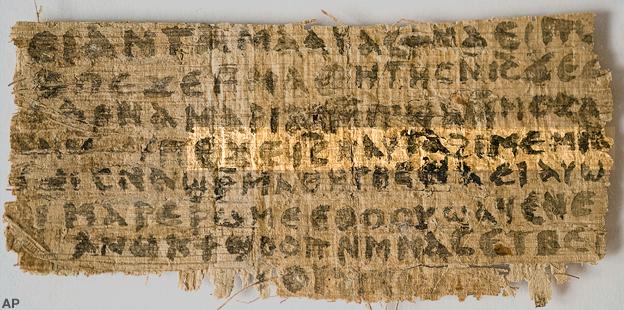
"Jesus said to them, 'My wife'" highlighted.

“Jesus said to them, ‘My wife'” highlighted.

I had previously written about the so-called Jesus’ Wife fragment that was brought to the public’s attention in 2012 by Karen King of Harvard Divinity School (here, here, and here). It was greeted by a lot of controversy regarding its authenticity, with the evidence leaning heavy in the direction of forgery. We had been waiting for tests to be performed on the papyrus and ink for well over a year to see if they also pointed in the direction of forgery. Those results finally came out in April 2014. It turns out that the materials are old (~8th century A.D.), but not nearly as old as King initially suggested and the paleographic evidence indicated (4-5th century A.D.).

Despite the ~300 year difference between estimated age and actual age of the papyrus, this seemed to be a vindication for King against those who argued that it is a modern forgery.  But is it?  Couldn’t it be a modern forgery using ancient materials?  After all, no forger buys his paper at the local Wal-Mart!  We would expect a forger to use an old papyrus for his forgery, so an analysis of the materials alone is not sufficient to tell us whether this is a forgery (it can confirm forgery, but not preclude it).  The analysis of the contents (vocabulary, grammar, writing style, etc.) is equally important, if not more important than the material composition itself for evaluating authenticity.

(more…)

Holy Spirith - The GhostAs anyone familiar with the KJV will notice, when speaking of the Spirit, the translators were not always consistent. The translators translated pneuma as “Spirit,” but translated pneuma hagios as “Holy Ghost.” Here are some examples where the difference can be seen within the same verse:

• Luke 4:1 And Jesus being full of the Holy Ghost returned from Jordan, and was led by the Spirit into the wilderness,
• John 1:33 And I knew him not: but he that sent me to baptize with water, the same said unto me, Upon whom thou shalt see the Spirit descending, and remaining on him, the same is he which baptizeth with the Holy Ghost.
• John 7:39 But this spake he of the Spirit, which they that believe on him should receive: for the Holy Ghost was not yet given; because that Jesus was not yet glorified.)
• Acts 2:4 And they were all filled with the Holy Ghost, and began to speak with other tongues, as the Spirit gave them utterance.
• 1 Corinthians 12:3 Wherefore I give you to understand, that no man speaking by the Spirit of God calleth Jesus accursed: and that no man can say that Jesus is the Lord, but by the Holy Ghost.

I was tempted to conclude that, for some stylistic reason or due to cultural conventions, the translators preferred to translate pneuma by itself as “Spirit,” but pneuma hagios as “Holy Ghost.” But I have discovered that they did not always translate pneuma hagios (or its Hebrew equivalent) as “Holy Ghost.” Consider these passages:

(more…)

Christian apologists have long pointed out that when it comes to textual reliability, the NT is in a league of its own compared to all other ancient texts.  According to NT manuscript expert Daniel Wallace, there are 1000x more copies of the NT than the average ancient Greek text.  If we stacked the NT manuscripts on top of each other, they would reach more than a mile high.  Not only are there more manuscripts for the NT than any other ancient text, but the gap between the original text and our first copies is smaller for the NT than other ancient texts.  There are 3x as many NT manuscripts within 200 years of the original text than the average Greco-Roman text has in 2000 years.

Unfortunately, many of the statistics appearing in apologetics literature are outdated.  Additional manuscripts of both the NT and other ancient texts continue to be discovered.  Clay Jones wrote an article for the Christian Research Institute in 2012 providing the latest stats.  The article was recently posted on the CRI website.  Check it out and see how the NT compares to other ancient Greek texts.

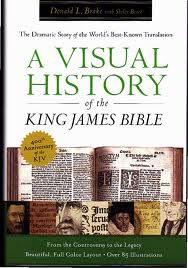
Visual History of KJVWhen the KJV turned 400 years old in 2011, there were a number of books published to celebrate and explore this historic, influential translation. One of those books was A Visual History of the King James Bible: The Dramatic Story of the World’s Best-Known Translation by Donald L. Brake.  I picked it up earlier this year via a scratch and dent special through CBD, and I’m glad I did.  It is chocked-full of interesting (and not-so-interesting) information about the history of the KJV.

Brake covers everything from the impetus for the translation to its modern form.  He begins with a brief overview of the history of the English language and the first English translations of Scripture.  Politics and religious factions caused a tug-of-war when it came to the production and acceptance of new translations.  No English translation gained universal acceptance. While the KJV did not immediately gain the adoration of all English speakers, within 30 years it had supplanted most other prior translations, and only continued to gain more and more market share until it became the standard translation in the English speaking world with no serious challengers until the late 19th century.

(more…)

According to Daniel Wallace:

The total number of catalogued Greek New Testament manuscripts now stands at 128 papyri, 322 majuscules, 2926 minuscules, and 2462 lectionaries, bringing the grand total to 5838 manuscripts.

CSNTM has also “discovered” two more minuscule manuscripts in the summer of 2013 on our European expeditions which will most likely receive their Gregory-Aland numbers in due time.

Apologetics DefenseSome Christians think that if we appeal to reason and evidences to demonstrate that the Bible is truly God’s Word, then we are elevating reason and evidence to a place of authority over God’s Word.  I think this conclusion is misguided for several reasons.  First, I don’t think it is legitimate to consider reason an “authority.”  Reason is merely a tool for assessing reality.  It is basic to all human thought.  Indeed, one cannot even understand God’s revelation apart from reasoning.  It would be a mistake, then, to pit reason against revelation as if they are two competing authorities.  As Greg Koukl has argued, using reason to assess whether or not the Bible is God’s revelation to man no more puts reason above the Bible than using grammar to understand God’s revelation puts grammar above the Bible.

Secondly, this confuses the order of being (ontology) with the order of knowing (epistemology). While the Bible is first in terms of authority, it is not first in terms of the order of knowing. Knowledge of the divine origin and revelatory status of the Bible is not innate. We must acquire this knowledge.  Knowledge of a proposition requires three elements: (1) belief that the proposition is true; (2) justification for the belief that the proposition is true; (3) the proposition must actually be true.  Put another way, knowledge is justified true belief.  Given the fact that knowledge requires justification, it cannot be wrong to require justification for believing the Bible is God’s Word.  We could not know the Bible is God’s Word apart from such justification.  As Kelly Clark has pointed out, reason is not autonomous as the standard of truth, but it is the best tool for discovering the truth. 

A proper use of reason is not an exercise of subjecting God’s Word to a higher authority, but an examination of the Bible to determine if it is truly what it claims to be.  We use our God-given reason to discover the truth that the Bible is a product of divine revelation.

Moses writingGenesis 14:14 describes Abram’s rescue of Lot as follows: “When Abram heard that his kinsman had been taken captive, he led forth his trained men, born in his house, 318 of them, and went in pursuit as far as Dan.”  

Dan was the name given to a city in the northern-most territory in Canaan, occupied by the descendents of Dan, the son of Jakob.  Given the fact that the descendents of Dan did not occupy this area until after the Conquest of Canaan, this could be pointed to as evidence that Genesis (or at least this periscope within Genesis) was not written until some time after the conquest of Canaan.  Seeing that Moses died before the Israelites entered Canaan, he could not have written this account. 

There are at least two possible rebuttals.  One would be to suggest that the identification of this area as “Dan” was due to a later updating of the text.  On this view, Moses wrote this periscope and used the name of the city/region as it was called in his day.  Later scribes, however, updated the text to reflect the modern names of the cities and regions Moses spoke of since modern readers would not be familiar with the ancient names.  

(more…)

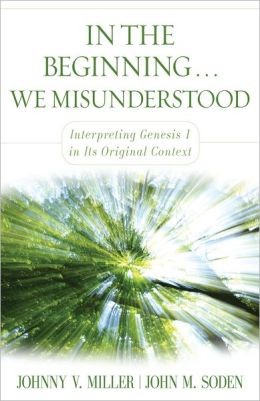
In the Beginning We MisunderstoodMost books dealing with the proper interpretation of Genesis 1 attempt to do one of two things: show how Genesis 1 cannot be reconciled with modern science, or show how Genesis 1 can be reconciled with modern science.  Some try to show that Genesis presents us with a young universe, while others try to show that Genesis presents us with an old universe.  Either way, it is presumed that Genesis 1 intends to present us with a scientific description of how God created (order, duration, etc.). 

In their new book, In the Beginning…We Misunderstood: Interpreting Genesis 1 in Its Original Context, coauthors Johnny Miller and John Soden argue that this presumption is false, and concordism is a misguided hermeneutical approach to Genesis 1.  Discussions over the meaning of Genesis should not be driven by scientific questions, but by literary questions.  Our interpretation of Genesis should not be determined by our views about science, but by the text itself.  Why even think that God meant to provide a scientific description of creation?  The most important question to ask is what Moses meant when he wrote the creation account, how his readers would have understood it, and what practical impact it would have for them given their unique historical situation.  How did it prepare them for the theology and religious practices they were familiar with in Egypt, as well as those they would encounter in Canaan? 

(more…)

« Previous PageNext Page »