Here is a great video summarizing the homily to the Hebrews.
July 17, 2015
Here is a great video summarizing the homily to the Hebrews.
May 18, 2015
We rightfully bemoan the rise of the gay hermeneutic in which Christians are reinterpreting the Bible to allow for committed same-sex relationships, but has anyone ever stopped to think that what these liberals are doing to the homosex texts we “conservatives” have already done to the divorce and remarriage texts? We have mangled Jesus and Paul’s teachings to allow for divorce for reasons other than sexual immorality, and to allow those who have divorced or have been divorced without grounds to remarry because we don’t think it is fair for people to be unhappy or alone. We understand the strong desire to be in a loving, sexual relationship. Our emotions become the motivating factor for reinterpreting (or ignoring) what would otherwise seem to be a pretty straightforward condemnations for most divorces and remarriages.
May 14, 2015
“Heresy” is a word that gets thrown around rather loosely these days. We will cavalierly declare someone a heretic because their views on eschatology differ from our own. It’s famously been said that “heresy is what you believe, while orthodoxy is what I believe.” But heresy is not the same as error. Not all theological errors or false doctrines rise to the level of heresy. A heresy is a belief held by a confessing Christian that is sufficient to damn their soul. To charge someone with heresy is not merely to say that their theology is wrong, but that it is so wrong that they do not qualify as a Christian and are not saved.
May 8, 2015
Jesus charged his apostles – and by extension, his church – with the great commission. The mission he gave us involves both the proclaiming of the gospel as well as the discipling of those who put their trust in Jesus.
If we are honest with ourselves, the American church is not great at either proclaiming or discipling, but we are doing worse on the proclaiming end, and it’s only getting worse. As our culture becomes increasing secular and as Christians increasingly buy into the notion that our faith is to be kept private, we are becoming increasingly reluctant to proclaim Jesus. There are a host of reasons for this, but I am not concerned to analyze them at this point. Instead, I want to focus on the type of evangelism we are opting for in its place. Some have called it “lifestyle evangelism.” Lifestyle evangelism entails the notion that the way we live our life is the best witness of Jesus. Our lives are a living gospel. This form of evangelism is summed up in the apocryphal quote attributed to Francis Assisi: “Preach the gospel. If necessary, use words.”
April 7, 2015
In light of my recent post regarding religious freedom, Lowder with Chowder has a great video talking about this issue. He illustrates it by showing what happens when a supposedly homosexual man asks a number of Muslim bakeries to bake him a same-sex wedding cake. The end is great too. He addresses the idea that people should not go into business unless they have no conscience or are willing to violate their conscience are willing to provide their services for any purpose.
March 27, 2015
Some people value Christian ethics, but deny that Christianity itself is true. This makes no sense. The truth of Christian ethics is directly dependent on the truth of Christian metaphysics. If Christian metaphysics are mistaken, then the ethics that flow from those metaphysics have no basis in reality (on the Christian worldview).
Granted, it could still be the case that Christian ethics are still true in toto or in part, even if Christian metaphysics is false. But in that case, they are true in virtue of the truth of some other metaphysical worldview or meta-ethical system. So why continue to embrace these ethics as CHRISTIAN ethics if their truth is grounded in something other than Christianity? It’s one thing to affirm that Christian ethics are true even if Christianity isn’t, but it’s another thing to subscribe to Christian ethics as CHRISTIAN ethics while denying that Christianity is true.
March 3, 2015
Many Christians wonder whether God will forgive them for intentional sin – particularly premeditated and habitual sins. It’s easy to believe God will forgive us for accidental sins, but not for sins that we plan out in advance or choose to do over and over again.
So, will God forgive such sins? Before we answer that question we should be clear about what God thinks of these sins. He hates them because He hates all sin. Sin is contrary to His holy nature. Sin ruptures God’s relationship with us, and this grieves Him. He has given us the power to choose righteousness (Romans 6; 8:1-4) and yet we choose unrighteousness instead. (more…)
February 27, 2015
Ben Witherington III has argued that references to Jesus returning “soon” are based on a mistranslation of en taxei. Rather than referring to when Jesus will come (soon), it refers to how Jesus will come when He does (quickly). This is important to claims that the NT teaches that Jesus was expected to return in the first century, or the expectation of a pre-tribulation return of Christ.
___________________
[1]Ben Witherington III, “’En Taxei’ – Quickly or Soon?”; available from http://www.patheos.com/blogs/bibleandculture/2015/01/25/en-taxei-quickly-or-soon/; Internet; accessed 17 February 2015.
February 26, 2015
That’s an easy answer: p52 (a fragment of John 18). Perhaps not. P52 is typically dated to A.D. 125-175. There is a fragment of Matthew 21, p104, that is dated to A.D. 100-200. The mean age of both manuscripts is A.D. 150, but if p104 is as early as its terminus a quo, then p104 may be the earliest NT manuscript.
Of course, there is still the possibility that we have a fragment of Mark’s gospel dated to before A.D. 90. The court is still out on this one since the research on this fragment has yet to be published. If it turns out to be a valid date, it would be the first NT fragment from the first century to be discovered – an exciting prospect indeed!
February 24, 2015
Now that Colorado, Washington, Oregon, Alaska, and Washington D.C. have legalized the recreational use of marijuana, more Christians are asking whether smoking marijuana is truly immoral. After all, it’s legal.[1] Joe Carter has a thoughtful article on this issue that I found extremely helpful.[2] He argues that smoking marijuana is immoral. Here is Carter’s argument in a nutshell (with some ad-lib on my part at certain points): (more…)
February 23, 2015
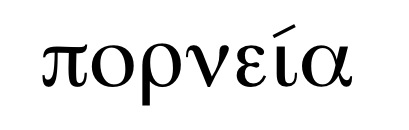
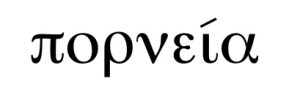
David Janzen wrote an article in 2001 that was published in the Journal for the Study of the New Testament on the meaning of porneia in Matthew 5:32 and 19:9.[1] In Matthew’s account of Jesus’ teaching on marriage and divorce, Jesus only allows for divorce in cases of porneia. But what does this refer to? It’s usually translated as “adultery,” but the Greek word for adultery is moicheia. Porneia has a wider semantic rate, referring to a range of sexual sins. It can be used of adultery, incest, pre-marital sex, etc.
Janzen argues that Jesus’ use of porneia is best understood from the cultural context. In Jesus’ day, some argued that divorce could be obtained for any reason, while others argued that one must have just cause. All agreed, however, that the husband only had to return the wife’s dowry to her if he had just cause for divorcing her. Jesus sided with those who taught that the only justification for divorce was a just cause. He identified that cause as porneia. What does porneia refer to? Is he referring to a wide range of sexual sins? Janzen argues that the cultural context makes it likely that porneia refers specifically to something akin to adultery. Why didn’t Matthew use moicheia, then? The most likely explanation is that Jesus was not limiting the exception to sex with another person during the marriage (adultery), but was also including sex with another person during the betrothal period (which, in Jesus’ day, was as legally binding as marriage).
Check out the article: Porneia in Mt 5_32 and 19_9–Janzen
_____________________
[1]David Janzen, “The Meaning of Porneia in Matthew 5:32 and 19:9: An Approach From the Study of Ancient Near Eastern Culture,” in Journal for the Study of the New Testament, 2001; 23; 66; available from http://jnt.sagepub.com/cgi/content/abstract/23/80/66.
February 16, 2015
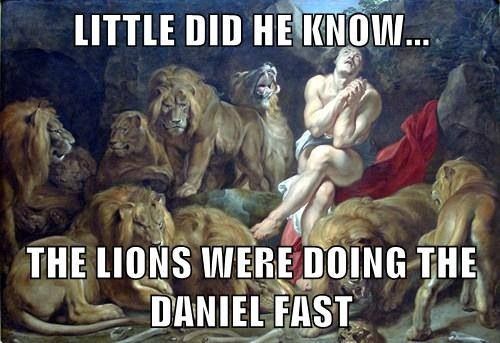
Whenever an all-church fast is called, pastors commonly give people a range of fasting options to engender wider participation. On the one extreme, total abstention from food and drink (except water) is called for. On the other extreme is what is often called “the Daniel Fast.” This is usually defined as eating only vegetables and drinking liquids.
Two passages of Scripture are called upon to support the Daniel Fast: Daniel 1:8-16 and 10:2-3. We’ll look at both in turn to see whether either of them teach a fast involving the eating of only vegetables. (more…)
February 4, 2015
Some believe the Biblical stories were myths or exaggerations. At worst, everything is an invention. At best, just the miracle claims were invented. When you examine the Gospels, however, you find plenty of evidence that the authors were being faithful to what really happened, even when it was embarrassing. Examples abound, including Peter’s denial of Jesus, Jesus calling Peter “Satan,” the disciples not understanding Jesus’ predictions of His resurrection, etc. This is called the principle of embarrassment, and is one of the key principles historians use to judge the historicity of a report.
While reading Matthew the other day, another example of this principle stood out to me in a way it had not before. We are told by Matthew that the chief priests went to Pilate “the next day” after Jesus had been crucified and buried to ask for guards to be posted at the tomb (Mt 27:62-63). Why? Because Jesus had predicted that He would rise from the dead, and they feared that the disciples might come and steal his body from the tomb and then claim Jesus’ prediction had come true (Mt 27:64). (more…)
January 6, 2015
Holiness churches are concerned with preserving the God-given distinction between men and women, and rightly so. That’s why many holiness churches teach that women should wear skirts/dresses and grow their hair long while men should wear pants and cut their hair short. It is ironic, then, that a number of holiness churches do not allow their male members to grow facial hair or view it as unfavorable when facial hair is the only natural, publically visible, God-given distinction between the sexes. While men can grow their hair long and women can cut their hair short, and while men can dress effeminate and women can dress masculine, only men can grow facial hair. Raymond Crownover noted this inconsistency in his response to a paper presented at the first Urshan Graduate School of Theology symposium in May 2002, writing: (more…)
January 5, 2015
Men and women were created differently. The God-given distinction between the two genders should be not be blurred, but preserved and celebrated. That’s why I am opposed to men shaving their facial hair. Facial hair is the only natural, publically visible, God-given distinction between the sexes. While men can grow their hair long and women can cut their hair short, and while men can dress effeminate and women can dress masculine, only men can grow facial hair. It is the unique differentiator between men and women, and thus should be preserved.
Facial hair is part of God’s creative design. And since the ability to grow facial hair is unique to the male gender, it seems obvious that God provided facial hair to men as a distinguishing feature of their gender. If God did not want men to have facial hair, why would He have included it in our design? What makes us think that have the liberty to artificially remove this God-given gender distinction? For a man to shave his face is to say to the Creator, “You did not make me right. This hair on my face was a mistake.” When a man shaves his face, He is violating God’s creative intent and attempting to erase a unique stamp of his masculinity afforded to him by God. (more…)
December 28, 2014
Are the words in the Bibles we read today the same words that the apostles and prophets wrote back then? Many people assume that the words have been dramatically changed over the centuries, comparing the transmission of Scripture to the Telephone Game. Daniel Wallace answers this challenge, showing how different the two really are: (more…)
December 18, 2014
Postmodern Christians who dismiss the veracity of propositional truth like to cite John 14:26 where Jesus said, “I am the way, the truth, and the life.” “Jesus is the truth,” they say, “not doctrinal statements. Jesus is the only truth that matters.”
This way of interpreting Jesus’ statement presumes that Jesus is saying He is identical to the truth, such that to speak of the truth is to speak of Jesus. Linguists call this the “is of identity.” An example of this use of “is” would be the statement, “Barack Obama is the president of the United States.” There is an identity relationship between the man Barack Obama and the office of the president of the United States. Clearly that’s not the kind of “is” Jesus is referring to. When Jesus says he is the truth, he is not making an identity statement such that “Jesus = the truth,” otherwise, “to say that ‘2+2=4’ is true is to say that ‘2+2=4’ is Jesus. In other words, Jesus is claiming to be a mathematical statement.”[1]
June 12, 2014
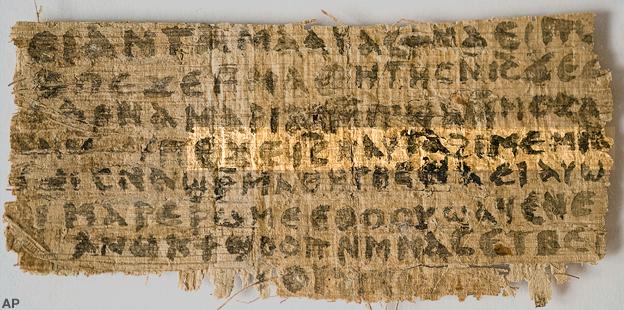
I had previously written about the so-called Jesus’ Wife fragment that was brought to the public’s attention in 2012 by Karen King of Harvard Divinity School (here, here, and here). It was greeted by a lot of controversy regarding its authenticity, with the evidence leaning heavy in the direction of forgery. We had been waiting for tests to be performed on the papyrus and ink for well over a year to see if they also pointed in the direction of forgery. Those results finally came out in April 2014. It turns out that the materials are old (~8th century A.D.), but not nearly as old as King initially suggested and the paleographic evidence indicated (4-5th century A.D.).
Despite the ~300 year difference between estimated age and actual age of the papyrus, this seemed to be a vindication for King against those who argued that it is a modern forgery. But is it? Couldn’t it be a modern forgery using ancient materials? After all, no forger buys his paper at the local Wal-Mart! We would expect a forger to use an old papyrus for his forgery, so an analysis of the materials alone is not sufficient to tell us whether this is a forgery (it can confirm forgery, but not preclude it). The analysis of the contents (vocabulary, grammar, writing style, etc.) is equally important, if not more important than the material composition itself for evaluating authenticity.
April 11, 2014
As anyone familiar with the KJV will notice, when speaking of the Spirit, the translators were not always consistent. The translators translated pneuma as “Spirit,” but translated pneuma hagios as “Holy Ghost.” Here are some examples where the difference can be seen within the same verse:
• Luke 4:1 And Jesus being full of the Holy Ghost returned from Jordan, and was led by the Spirit into the wilderness,
• John 1:33 And I knew him not: but he that sent me to baptize with water, the same said unto me, Upon whom thou shalt see the Spirit descending, and remaining on him, the same is he which baptizeth with the Holy Ghost.
• John 7:39 But this spake he of the Spirit, which they that believe on him should receive: for the Holy Ghost was not yet given; because that Jesus was not yet glorified.)
• Acts 2:4 And they were all filled with the Holy Ghost, and began to speak with other tongues, as the Spirit gave them utterance.
• 1 Corinthians 12:3 Wherefore I give you to understand, that no man speaking by the Spirit of God calleth Jesus accursed: and that no man can say that Jesus is the Lord, but by the Holy Ghost.
I was tempted to conclude that, for some stylistic reason or due to cultural conventions, the translators preferred to translate pneuma by itself as “Spirit,” but pneuma hagios as “Holy Ghost.” But I have discovered that they did not always translate pneuma hagios (or its Hebrew equivalent) as “Holy Ghost.” Consider these passages: