Theology


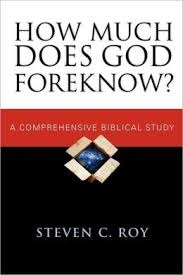
God ForeknowA couple of years ago a friendly soul purchased Steven C. Roy’s book, How Much Does God Foreknow from my Ministry Resource List.  Other research, however, prevented me from getting to this book until now.

As the title implies, the purpose of the book is to explore the question of God’s foreknowledge. It is meant to be a critical evaluation of open theism, which is the view that God cannot know the future, free choices made by moral agents because the future does not exist. One of the strengths of Roy’s work is that he interacts directly with Open Theists, quoting them at length.  This avoids the potential for constructing a straw man argument, and allows the reader to consider Open Theists arguments for themselves.

(more…)

discipleship2Jesus said we are to make “disciples” — not just believers (Mt 28:19). For Jesus, making disciples involves more than baptism (conversion); it involves teaching them as well. Spiritual development requires knowledge, not just an experience.

To be discipled is to be taught. Jesus taught His disciples for 3+ years. Apparently, there is a lot to know to do the work of God and be the kind of Christian Jesus wants us to be! And yet today, most churches stop training Christians after a simple Bible study. Christians are not taught theology from the pulpit, but merely encouraged to keep the faith week after week.

(more…)

ModestyThere is a difference between a woman making herself attractive and making herself seductive.  The former enhances her natural beauty to increase a man’s desire for her, whereas the latter enhances her sexual appeal and increases a man’s desire to use her to satisfy his sexual lusts.  In other words, the former enhances her value as a person, whereas the latter devalues her to a mere object of lust.

Modesty cannot be legislated by prescribing certain forms of clothing, certain lengths, or a certain fit.  Women must be responsible for their own modesty.  With every outfit they put on they should be asking themselves, “Does this outfit enhance my natural beauty, or does it enhance my sex appeal to men?  Will this cause men to objectify me, or value me as a woman?”  If women asked these questions of themselves each morning, and if they asked it of other men, no church would have to have standards of modesty.

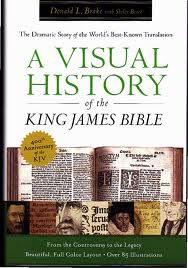
Visual History of KJVWhen the KJV turned 400 years old in 2011, there were a number of books published to celebrate and explore this historic, influential translation. One of those books was A Visual History of the King James Bible: The Dramatic Story of the World’s Best-Known Translation by Donald L. Brake.  I picked it up earlier this year via a scratch and dent special through CBD, and I’m glad I did.  It is chocked-full of interesting (and not-so-interesting) information about the history of the KJV.

Brake covers everything from the impetus for the translation to its modern form.  He begins with a brief overview of the history of the English language and the first English translations of Scripture.  Politics and religious factions caused a tug-of-war when it came to the production and acceptance of new translations.  No English translation gained universal acceptance. While the KJV did not immediately gain the adoration of all English speakers, within 30 years it had supplanted most other prior translations, and only continued to gain more and more market share until it became the standard translation in the English speaking world with no serious challengers until the late 19th century.

(more…)

Christians often disagree regarding matters of personal holiness.  Those defending themselves against the charge of sin for some X will often respond by saying, “It’s not that bad.”  Of course, to say something is “not that bad” is tantamount to saying it’s “not that good” either.  In such cases, we should be honest with ourselves and others and just admit that X is not spiritually advantageous for us, even if it is morally tolerable.  Would we be better off if we abstained?  Perhaps.  Are we sinning if we don’t?  No.

(more…)

EmpiricismThose who subscribe to empiricism believe that we should not believe the truth of some X based on a competent authority.  We are only justified in believing some X if we have empirically verifiable evidence supporting the truth of X.  It goes without notice that this principle itself is not empirically verifiable, and thus empiricism is self-refuting as a complete theory of knowledge.  But let’s ignore the man behind the curtain for a moment, and explore other deficiencies in an empirical epistemology.

In his book, A Universe from Nothing, physicist and empiricist Lawrence Krauss describes the state of the cosmos in the distant future.  Due to cosmic expansion, in two trillion years all of the evidence for the Big Bang (cosmic microwave background, redshift of distant objects/the Hubble expansion, and the measurement of light elements in the cosmos), and all 400 billion galaxies visible to us now, will no longer be detectable via empirical methods.  Worse yet, all of the evidence for the dark energy that caused the cosmic expansion will be gone as well.  For scientists living in that day, all of the empirical evidence will point to a static universe inhabited by a single galaxy that is no more than a trillion years old (based on the ratio of light elements at the time).

(more…)

Empty prisons2Nobody likes the idea of hell – even believers – but many unbelievers simply loathe the concept.  They think punishing sinners in hell is not befitting of a supposedly loving God, and appeal to the doctrine as evidence against the truth of Christianity.  Is hell truly a stain on God’s character?  I don’t think so, and when the skeptic examines his own beliefs about justice a bit more carefully, I think he’ll come to agree that hell is not the egregious concept he claims it is.  Here’s a tactical way to get your skeptical friend to see this point.

(more…)

According to Daniel Wallace:

The total number of catalogued Greek New Testament manuscripts now stands at 128 papyri, 322 majuscules, 2926 minuscules, and 2462 lectionaries, bringing the grand total to 5838 manuscripts.

CSNTM has also “discovered” two more minuscule manuscripts in the summer of 2013 on our European expeditions which will most likely receive their Gregory-Aland numbers in due time.

IFWe should not confuse permissiveness for grace. Grace says, “I love you and forgive you, so you need to stop this sin,” not “I love you and forgive you, so it doesn’t matter what you do.”  We are living in a culture that thinks love and forgiveness mean we should permit people to continue in their sin while we continue in our silence.  This is not grace, and this is not love.  Grace and love will always confront sin, because grace and love are the remedy for sin, not the license to continue in it.

unfairCalvinism is distasteful to many people, including myself – and even many Calvinists – because it teaches that God has only chosen to save some human beings even though He has the power to save all.  This seems unfair.  It makes God’s will seem arbitrary.  After all, why would He choose to save person X but not person Y if He loves them both, and has the power to save both?  Many who reject Calvinism reject it for this reason alone. 

While there are formidable theological, exegetical, and philosophical[1] problems with Calvinism, I’ve come to think that the “fairness” objection is not a good argument against Calvinism.  First, there is nothing unfair about God’s choosing to save some but not others.  God is not obligated to save anyone.  Those who commit moral crimes all deserve to be punished for their crimes.  When they are punished, they are punished justly.  If God chooses to save some, He is not acting unjustly, but rather graciously.  It is similar to a governor who chooses to pardon some inmates, but not others.  Is this unfair?  No.  The inmates who were not pardoned are getting what they deserve.  They are rightfully paying for their crimes.  Those who are pardoned are objects of the governor’s grace.  The governor is not acting unfairly to extend mercy to some but not others, even if the public does not understand why he has chosen as he has. 

(more…)

Apologetics DefenseSome Christians think that if we appeal to reason and evidences to demonstrate that the Bible is truly God’s Word, then we are elevating reason and evidence to a place of authority over God’s Word.  I think this conclusion is misguided for several reasons.  First, I don’t think it is legitimate to consider reason an “authority.”  Reason is merely a tool for assessing reality.  It is basic to all human thought.  Indeed, one cannot even understand God’s revelation apart from reasoning.  It would be a mistake, then, to pit reason against revelation as if they are two competing authorities.  As Greg Koukl has argued, using reason to assess whether or not the Bible is God’s revelation to man no more puts reason above the Bible than using grammar to understand God’s revelation puts grammar above the Bible.

Secondly, this confuses the order of being (ontology) with the order of knowing (epistemology). While the Bible is first in terms of authority, it is not first in terms of the order of knowing. Knowledge of the divine origin and revelatory status of the Bible is not innate. We must acquire this knowledge.  Knowledge of a proposition requires three elements: (1) belief that the proposition is true; (2) justification for the belief that the proposition is true; (3) the proposition must actually be true.  Put another way, knowledge is justified true belief.  Given the fact that knowledge requires justification, it cannot be wrong to require justification for believing the Bible is God’s Word.  We could not know the Bible is God’s Word apart from such justification.  As Kelly Clark has pointed out, reason is not autonomous as the standard of truth, but it is the best tool for discovering the truth. 

A proper use of reason is not an exercise of subjecting God’s Word to a higher authority, but an examination of the Bible to determine if it is truly what it claims to be.  We use our God-given reason to discover the truth that the Bible is a product of divine revelation.

Moses writingGenesis 14:14 describes Abram’s rescue of Lot as follows: “When Abram heard that his kinsman had been taken captive, he led forth his trained men, born in his house, 318 of them, and went in pursuit as far as Dan.”  

Dan was the name given to a city in the northern-most territory in Canaan, occupied by the descendents of Dan, the son of Jakob.  Given the fact that the descendents of Dan did not occupy this area until after the Conquest of Canaan, this could be pointed to as evidence that Genesis (or at least this periscope within Genesis) was not written until some time after the conquest of Canaan.  Seeing that Moses died before the Israelites entered Canaan, he could not have written this account. 

There are at least two possible rebuttals.  One would be to suggest that the identification of this area as “Dan” was due to a later updating of the text.  On this view, Moses wrote this periscope and used the name of the city/region as it was called in his day.  Later scribes, however, updated the text to reflect the modern names of the cities and regions Moses spoke of since modern readers would not be familiar with the ancient names.  

(more…)

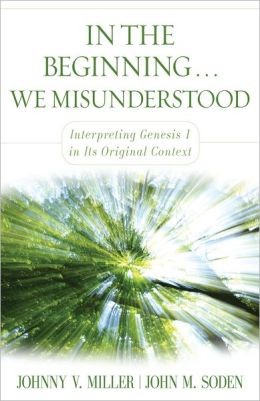
In the Beginning We MisunderstoodMost books dealing with the proper interpretation of Genesis 1 attempt to do one of two things: show how Genesis 1 cannot be reconciled with modern science, or show how Genesis 1 can be reconciled with modern science.  Some try to show that Genesis presents us with a young universe, while others try to show that Genesis presents us with an old universe.  Either way, it is presumed that Genesis 1 intends to present us with a scientific description of how God created (order, duration, etc.). 

In their new book, In the Beginning…We Misunderstood: Interpreting Genesis 1 in Its Original Context, coauthors Johnny Miller and John Soden argue that this presumption is false, and concordism is a misguided hermeneutical approach to Genesis 1.  Discussions over the meaning of Genesis should not be driven by scientific questions, but by literary questions.  Our interpretation of Genesis should not be determined by our views about science, but by the text itself.  Why even think that God meant to provide a scientific description of creation?  The most important question to ask is what Moses meant when he wrote the creation account, how his readers would have understood it, and what practical impact it would have for them given their unique historical situation.  How did it prepare them for the theology and religious practices they were familiar with in Egypt, as well as those they would encounter in Canaan? 

(more…)

The State of the Plate just released a report on the characteristics of tithers.  Their report is based on a five year study of 4,413 people.  They found that 

  • 77% of tithers give more than 10% (between 11-20%)
  • 70% base their tithe on their gross, rather than net income
  • 63% started tithing in their twenties or before
  • “Tithers carry much less debt than most people and are financially better off than Christian non-tithers — 80% of ‘tithers’ have no unpaid credit card bills; 74% have no car payments; 48% own their home; and 28% are completely debt-free.”
  • Only 10-25% of churchgoers tithe, which constitutes 50-80% of a churches funding.

Reasons cited by non-tithing Christians for not tithing include the lack of finances (38%), too much debt (33%), and lack of spousal approval (18%). And yet, State of the Plate found that those who tithe are “distributed almost equally across all income brackets.”  It seems that one’s personal debt may be one of the best indicators regarding their likelihood to tithe.


HT: Scot McKnight

Jesus CounselorThe modern approach to evangelism is to tell people how much God loves them, and that He can fix their broken lives and heal their emotional wounds. While this is true, too many Christians stop here. They make no mention of Jesus’ lordship over our lives, the coming judgment, or the forgiveness of sins.

No one continues to visit their counselor after their emotional problems have been resolved. When we only present Jesus as the solution for our emotional needs – a divine counselor – we should not be surprised when people try Jesus, and then move on to other things once they “feel” better.

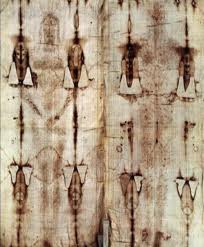
Shroud of TurinThe Shroud of Turin – the purported burial cloth of Jesus which contains the faint image of a crucified man – was the subject of intense scientific examination in the mid 1980s.  Based on a carbon-14 dating of the fibers, scientists dated the shroud to A.D. 1260-1390.  For most, this was all the proof they needed to conclude that the shroud was a medieval forgery.

Other evidence, however, suggests that it is genuine.  One theory put forward to explain the medieval date determined by C-14 dating is that the fibers used for the test were either contaminated (from either the lab, or from the fire in 1532 that nearly destroyed the Shroud), or were not part of the original Shroud (the Shroud was patched by weaving new threads into the old threads).

Recently, a group of scientists in Italy conducted tests on the fibers using three different dating methods and concluded that the Shroud dates to 33 BC, ±250 years.  These dating methods utilized infra-red light, Raman spectroscopy (“the measurement of radiation intensity through wavelengths”), and a mechanical process utilizing electricity.

I cannot speak to the accuracy of these dating methods, but given the fact that three different dating methods all arrived at dates more than a Millennium earlier than the C-14 dates is quite interesting.  It gives evidential backing to those who questioned the accuracy of the C-14 tests.  At the very least, the authenticity of the Shroud can no longer be dismissed out-of-hand based solely on the C-14 tests.  The new data fits perfectly with a first century dating of the Shroud.  It will be interesting to see how other scholars respond to this new data.
Barna Research Group reports that the number of American adults who view the Bible as “just…a book of stories and teachings written by men” has increased from 10% in 2011 to 17% in 2013.  That’s a significant increase in just two years.

Read the entire report here.

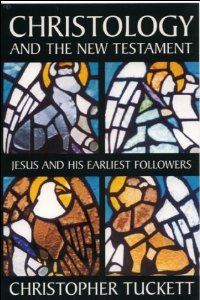
Christology and NTI purchased Christology and the New Testament by Christopher Tuckett a couple of years ago, but just finally got around to reading it recently.

This book takes a look at the subject of Christology, but from a purely Biblical perspective (no post-apostolic theological development or creedal affirmations are considered).  Tuckett, who teaches NT at the University of Oxford, looks at how each NT author presents Jesus, particularly through – but not limited to – their ascription of various titles to Jesus.  While Tuckett is liberal in his theological conclusions (and it’s not even clear that he is a confessing Christian), his presentation of the Biblical data is quite good.  He has a great way of bringing out the Christological emphasis of the different NT authors/books.

If you are looking for a good introduction to NT Biblical Christology, this is a good resource.

Dan Wallace reports on the release of a new New Testament.  A band off 19 liberal Christian and Jewish scholars got together for a “council” and decided to add 13 new books (two are prayers, and one is a song) to the New Testament.

Given some of those on this council (Karen King, John Dominic Crossan), it’s no surprise that they are Gnostic in character.  Both the “council” and the new testament they produced is a farce.

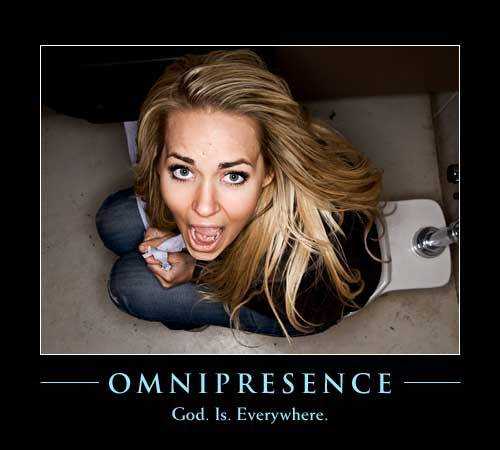
Omnipresence toiletOmnipresence is one of God’s attributes.  As I argued in an article at The Institute for Biblical Studies, however, this property is not essential to God’s nature and should not be understood in spatial terms.  God is not a spatial being, and thus He does not exist anywhere, similar to the way in which we should not understand God’s eternal existence to mean He existed before creation.  “Before” is a temporal concept, and since time began with creation it is meaningless to speak of anything before creation.  Instead, we should speak of God’s existence without creation.

Similarly, as a non-spatial being God cannot exist in any spatial location.  To think of God’s omnipresence in terms of occupying points in space is a category error, similar to saying the number seven tastes delicious.  To say God is omnipresent refers to God’s cognizance of and causal activity at all points in the spatial dimension.

« Previous PageNext Page »