 Now that Colorado, Washington, Oregon, Alaska, and Washington D.C. have legalized the recreational use of marijuana, more Christians are asking whether smoking marijuana is truly immoral. After all, it’s legal.[1] Joe Carter has a thoughtful article on this issue that I found extremely helpful.[2] He argues that smoking marijuana is immoral. Here is Carter’s argument in a nutshell (with some ad-lib on my part at certain points): (more…)
February 24, 2015
Should Christians smoke marijuana?
Posted by Jason Dulle under Hamartiology, Holiness, Theology[18] Comments
February 23, 2015
The meaning of porneia in Matthew 5:32 and 19:9 – What was Jesus’ justification for divorce?
Posted by Jason Dulle under Marriage and Divorce, Theology[12] Comments
 David Janzen wrote an article in 2001 that was published in the Journal for the Study of the New Testament on the meaning of porneia in Matthew 5:32 and 19:9.[1] In Matthew’s account of Jesus’ teaching on marriage and divorce, Jesus only allows for divorce in cases of porneia. But what does this refer to? It’s usually translated as “adultery,” but the Greek word for adultery is moicheia. Porneia has a wider semantic rate, referring to a range of sexual sins. It can be used of adultery, incest, pre-marital sex, etc.
Janzen argues that Jesus’ use of porneia is best understood from the cultural context. In Jesus’ day, some argued that divorce could be obtained for any reason, while others argued that one must have just cause. All agreed, however, that the husband only had to return the wife’s dowry to her if he had just cause for divorcing her. Jesus sided with those who taught that the only justification for divorce was a just cause. He identified that cause as porneia. What does porneia refer to? Is he referring to a wide range of sexual sins? Janzen argues that the cultural context makes it likely that porneia refers specifically to something akin to adultery. Why didn’t Matthew use moicheia, then? The most likely explanation is that Jesus was not limiting the exception to sex with another person during the marriage (adultery), but was also including sex with another person during the betrothal period (which, in Jesus’ day, was as legally binding as marriage).
Check out the article: Porneia in Mt 5_32 and 19_9–Janzen
_____________________
[1]David Janzen, “The Meaning of Porneia in Matthew 5:32 and 19:9: An Approach From the Study of Ancient Near Eastern Culture,” in Journal for the Study of the New Testament, 2001; 23; 66; available from http://jnt.sagepub.com/cgi/content/abstract/23/80/66.
February 16, 2015
 Whenever an all-church fast is called, pastors commonly give people a range of fasting options to engender wider participation. On the one extreme, total abstention from food and drink (except water) is called for. On the other extreme is what is often called “the Daniel Fast.” This is usually defined as eating only vegetables and drinking liquids.
Two passages of Scripture are called upon to support the Daniel Fast: Daniel 1:8-16 and 10:2-3. We’ll look at both in turn to see whether either of them teach a fast involving the eating of only vegetables. (more…)
February 10, 2015
If God Exists, Why Haven’t I Experienced Him?
Posted by Jason Dulle under Apologetics, Atheistic objections, Theistic Arguments[70] Comments
Most Christians are con vinced of God’s existence based on their personal experience of God rather than by rational argumentation (though some are convinced by a combination of experience and argument). This is a rational justification for such a belief. After all, we generally take our experiences to be veridical unless and until we have good reasons for thinking our experience was not veridical. An argument for God’s existence based on personal experience goes something like this:
- I seem to have had an experience of God
- I should trust my experiences unless I have good reasons to doubt their veracity
- I have no reason to doubt the veracity of my experience of God
- Therefore, I have experienced God
- Therefore, God exists
Atheists will often claim that they would also believe in God if they had a similar experience. It’s not uncommon for this claim to be followed up by a question: Why, if God exists, have they not experienced Him? (more…)
February 4, 2015
The Loop Matthew Did not Close: Evidence of Accurate Historical Reporting in the Gospel of Matthew
Posted by Jason Dulle under Bible, Bible Difficulties, Theology[10] Comments
 Some believe the Biblical stories were myths or exaggerations. At worst, everything is an invention. At best, just the miracle claims were invented. When you examine the Gospels, however, you find plenty of evidence that the authors were being faithful to what really happened, even when it was embarrassing. Examples abound, including Peter’s denial of Jesus, Jesus calling Peter “Satan,” the disciples not understanding Jesus’ predictions of His resurrection, etc. This is called the principle of embarrassment, and is one of the key principles historians use to judge the historicity of a report.
While reading Matthew the other day, another example of this principle stood out to me in a way it had not before. We are told by Matthew that the chief priests went to Pilate “the next day” after Jesus had been crucified and buried to ask for guards to be posted at the tomb (Mt 27:62-63). Why? Because Jesus had predicted that He would rise from the dead, and they feared that the disciples might come and steal his body from the tomb and then claim Jesus’ prediction had come true (Mt 27:64). (more…)
February 2, 2015
Lyrical heresies: What’s wrong with modern worship songs
Posted by Jason Dulle under Odds & Ends[23] Comments
 Singing is a spiritual exercise (Psalms; Ephesians 5:19; Colossians 3:16). Few things can open up hearts to God like beautiful music and meaningful lyrics. The effects of music on the soul are nothing short of amazing. That is why virtually all Christian congregations feature music in their services. But what we sing about is just as important as the fact that we are singing. After all, singing the latest Taylor Swift song would not be deemed spiritual just because it was sung in church. Content matters. But not just any ‘ol content that mentions God will do either.
Theologically Lean
I have been increasingly concerned over the years with the lyrical content of mainstream “worship” songs. Many of our songs suffer from theological anorexia. There’s not enough theological content in them to make the Devil yawn, yet alone choke. They are so generic that one may have a hard time telling what God they are talking about (if God is even mentioned). Then there are the “God of my girlfriend” songs that are spiritually androgynous. One can’t tell whether they are singing about their love for God or their love for their girlfriend. Finally, there are songs some have called “7-11” songs: They contain seven words sung 11 times. If you want to know what theologically robust songs look like, get yourself a hymnal that’s more than 30 years old. They are pregnant with theological substance. (more…)
January 30, 2015
Visual depiction of the moral argument
Posted by Jason Dulle under Apologetics, Moral Argument, Theistic Arguments[22] Comments
January 29, 2015
CA judges barred from belonging to the Boy Scouts
Posted by Jason Dulle under Apologetics, Homosexuality, Political Incorrectness[13] Comments
 The CA Supreme Court voted on Friday, January 23 to prohibit state judges from being affiliated with the Boy Scouts on the grounds that the Boy Scouts discriminate against gays. Apparently the Court voted in 1996 to prohibit judges from participating in any organization that discriminated against someone because of their sexual orientation, but had an exception clause for youth organizations including the Boy Scouts. That exception has been rescinded. This brings CA in line with 21 other states that have the same prohibition.
This ruling strikes me as troubling for a number of reasons: (more…)
January 12, 2015

January 6, 2015
 Holiness churches are concerned with preserving the God-given distinction between men and women, and rightly so. That’s why many holiness churches teach that women should wear skirts/dresses and grow their hair long while men should wear pants and cut their hair short. It is ironic, then, that a number of holiness churches do not allow their male members to grow facial hair or view it as unfavorable when facial hair is the only natural, publically visible, God-given distinction between the sexes. While men can grow their hair long and women can cut their hair short, and while men can dress effeminate and women can dress masculine, only men can grow facial hair. Raymond Crownover noted this inconsistency in his response to a paper presented at the first Urshan Graduate School of Theology symposium in May 2002, writing: (more…)
January 5, 2015
 Men and women were created differently. The God-given distinction between the two genders should be not be blurred, but preserved and celebrated. That’s why I am opposed to men shaving their facial hair. Facial hair is the only natural, publically visible, God-given distinction between the sexes. While men can grow their hair long and women can cut their hair short, and while men can dress effeminate and women can dress masculine, only men can grow facial hair. It is the unique differentiator between men and women, and thus should be preserved.
Facial hair is part of God’s creative design. And since the ability to grow facial hair is unique to the male gender, it seems obvious that God provided facial hair to men as a distinguishing feature of their gender. If God did not want men to have facial hair, why would He have included it in our design? What makes us think that have the liberty to artificially remove this God-given gender distinction? For a man to shave his face is to say to the Creator, “You did not make me right. This hair on my face was a mistake.” When a man shaves his face, He is violating God’s creative intent and attempting to erase a unique stamp of his masculinity afforded to him by God. (more…)
December 31, 2014
What I’ve Been Reading: God’s Battalions – The Case for the Crusades
Posted by Jason Dulle under Book Reviews[19] Comments
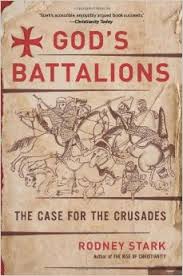 I have always heard the Crusades were an example of Christian imperialism, greed, intolerance, and involved all sorts of injustices and evils against Jews and Muslims that have served as a source of bitterness between Christians and Muslims ever since. After reading, God’s Batallions: The Case for the Crusades by Rodney Stark, I realize that this story of the Crusades is not one that matches the historical record. Among other things, Stark argues for the following propositions:
December 28, 2014
The Telephone Game and the Transmission of the Bible
Posted by Jason Dulle under Bible, Theology, Translations[8] Comments
 Are the words in the Bibles we read today the same words that the apostles and prophets wrote back then? Many people assume that the words have been dramatically changed over the centuries, comparing the transmission of Scripture to the Telephone Game. Daniel Wallace answers this challenge, showing how different the two really are: (more…)
December 19, 2014
Belief in Brute Facts is Not Rational: An Argument in Defense of the Principle of Sufficient Reason and the Cosmological Argument Based on the Existence of Contingent Beings
Posted by Jason Dulle under Apologetics, Atheistic objections, Cosmological Argument, Theistic Arguments[6] Comments
 Caleb Clanton wrote an article in the most recent volume of Philosophia Christi in defense of the cosmological argument.[1] More precisely, he argued for the principle of sufficient reason that undergirds the argument, and against the existence of brute facts which undercuts the argument. Here is a brief summary of his argument.
A contingent being is one whose existence is derived from a source outside of itself. Everything we see around us is a contingent being: trees, rocks, planets, stars, and even the universe itself. How did the set of all contingent beings originate? While the vast majority of all contingent beings can be explained by appealing to a prior contingent being, this cannot go on ad infinitum because an infinite regress is logically absurd. It follows, then, that the entire set of contingent beings cannot be explained by appealing to another contingent being because as the set of all contingent beings, there can’t be any additional contingent beings. Only a being that is not contingent can explain the set. A being that is not contingent is a necessary being, meaning it does not derive its existence from anything outside of itself, but has existence in and of itself by a necessity of its own nature. Theists identify this necessary being as God. (more…)
December 18, 2014
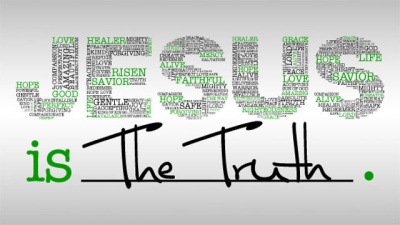 Postmodern Christians who dismiss the veracity of propositional truth like to cite John 14:26 where Jesus said, “I am the way, the truth, and the life.” “Jesus is the truth,” they say, “not doctrinal statements. Jesus is the only truth that matters.”
This way of interpreting Jesus’ statement presumes that Jesus is saying He is identical to the truth, such that to speak of the truth is to speak of Jesus. Linguists call this the “is of identity.” An example of this use of “is” would be the statement, “Barack Obama is the president of the United States.” There is an identity relationship between the man Barack Obama and the office of the president of the United States. Clearly that’s not the kind of “is” Jesus is referring to. When Jesus says he is the truth, he is not making an identity statement such that “Jesus = the truth,” otherwise, “to say that ‘2+2=4’ is true is to say that ‘2+2=4’ is Jesus. In other words, Jesus is claiming to be a mathematical statement.”[1]
December 16, 2014
What I’ve Been Reading: Darwin’s Doubt – Pt 7 of 7
Posted by Jason Dulle under Apologetics, Book Reviews, Intelligent Design[6] Comments
 For the previous installments: part 1, 2, 3, 4, 5, and 6.
Chapter 17
In this chapter, Meyer asks whether it is possible that the cause of the Cambrian explosion is an intelligent agent rather than naturalistic processes. He argues that it is, and that the design hypothesis is better supported by the evidence than any naturalistic hypothesis.
Meyer looks closely at how historical science works. It is different than physics and biology because you cannot experiment on the past. What you can do, however, is develop multiple and competing hypotheses to determine which is the best explanation for the evidence at hand (inference to the best explanation). One of the best ways to test competing hypotheses is on the basis of their causal adequacy; i.e. is the proposed cause adequate to produce the effect in question? Remember, we have to explain the origin of biological information. What sorts of causes, now in operation, are known to produce information? Only one: intelligent agents. If the basis of life is information, and the only known cause of information is intelligence, then it follows that an intelligent agent is not just the best explanation for biological information, but the only viable explanation. (more…)
December 15, 2014
The New Definition of Atheism is Compatible with God’s Existence
Posted by Jason Dulle under Apologetics, Atheism[2] Comments
 Atheists increasingly like to define atheism as the lack of belief in God rather than the affirmation that God does not exist, essentially transforming atheism from an ontological claim to a psychological state. Richard Howe recently had an interesting critique of this redefinition, pointing out that on this definition of atheism both atheism and theism could be true:
It is becoming increasingly more common for atheists to define atheism, not as the denial of the existence of God, but as a lack of belief in the existence of God. … This definition of atheism entails the quirky conclusion that atheism is logically compatible with theism. This is so because if atheism is the lack of a belief in god, then it could be the case both that atheism is true (i.e., it could be the case that George Smith, for example, lacks the belief in God) while at the same time that God actually exists.[1]
See also:
- What exactly does it mean to be an “atheist”?
- Not So Fast: There is No Presumption of Atheism
- Atheists may lack belief in God, but they do not lack beliefs about God
- No one is born an atheist
_____________
[1]Richard Howe, “God Can Exist Even if Atheism is True”; available from http://quodlibetalblog.wordpress.com/2011/11/15/god-can-exist-even-if-atheism-is-true/; Internet; accessed 15 December, 2014.
December 12, 2014
Federal judge strikes down Alaska marriage amendment, and other important court decisions
Posted by Jason Dulle under Apologetics, Same-sex Marriage[3] Comments
A federal judge struck down Alaska’s marriage amendment (approved in 1998) on October 12, 2014, effective October 13. And on October 6, the Supreme Court refused to hear a number of cases where five states were trying to protect their amendments, effectively legalizing same-sex marriage in 30 states. On October 7, the 9th district appeals court “overturned marriage bans in Nevada and Idaho.”
On November 6 a federal appeals court upheld the marriage laws of Ohio, Michigan, Kentucky, and Tennessee. Since different federal appeals courts came to different decisions, this may force SCOTUS to take up the issue.
December 12, 2014
What I’ve Been Reading: Darwin’s Doubt – Pt 6
Posted by Jason Dulle under Apologetics, Book Reviews, Intelligent Design1 Comment
For the previous installments: part 1, 2, 3, 4, 5.
Chapter 14
In principle, a neo-Darwinian explanation of the origin of new body plans can only work if body plans are wholly determined at the genetic level. If sources of information other than DNA are substantially responsible for the formation of body plans, then at best neo-Darwinism is inadequate as a holistic explanation for the diversification of life, and at worst it is simply the wrong explanation altogether.
Once again, modern discoveries in embryological development have discovered that there are many factors other than DNA that play a critical role in embryological development. For example, it’s been shown that in many organisms, you can completely remove the DNA from the developing cells and the embryo will continue to develop up to a certain point. If DNA alone was responsible for embryological development, this should be just as impossible as driving a car without gas. If the car is driving, and there is no gas in the tank, then clearly something other than gas must be powering the car. The same is true of embryological development. While DNA is necessary to embryological development, it is not sufficient in itself. There are sources of power other than DNA that are critical to the development of the organism. Scientists call such sources “epigenetic information,” meaning it is information beyond the genetic information coded in DNA.
December 11, 2014
Visual depiction of the fine-tuning of the universe for life
Posted by Jason Dulle under Apologetics, Cosmological Argument, Intelligent Design, Theistic Arguments[5] Comments
Here’s another great video from William Lane Craig, this time on the fine-tuning of the universe for the existence of life (see also his video on the kalam cosmological argument).

 Thinking to Believe