 There’s a difference between how we know something to be true (epistemology), and what makes that something true (ontology). Keeping this distinction in mind would illuminate many debates. For example, atheists often claim that one doesn’t need God to know morality and act morally. That’s true, but it misses the point. Just because one can know moral truths and behave morally without believing in God does not mean God is not necessary to explain morality. As Greg Koukl likes to say, that’s like saying because one is able to read books without believing in authors, authors are not necessary to explain the origin of books (author-of-the-gaps). In the same way books need authors, moral laws need a moral-law giver.
Atheism
Archived Posts from this Category
July 13, 2012
Morality and the Epistemology-Ontology Distinction
Posted by Jason Dulle under Apologetics, Atheism, Epistemology, Logic, Moral Argument, Philosophy, Theism, Theistic Arguments[36] Comments
July 12, 2012
Given materialism, is the concept of “rape” even meaningful?
Posted by Jason Dulle under Apologetics, Atheism, Determinism, Moral Argument, Naturalism, Relativism[7] Comments
 A friend of mine made a point the other day that I thought was insightful. If matter is all that exists, and there is no free will because everything is either determined or indeterminate, then there is no real distinction between rape and consensual sex since the distinction relies on the notion of free will. If the will is not free, then strictly speaking, no act of sex is chosen—even so called consensual sex is not chosen. Every act of sex is chosen for us by forces that lie outside of our control. We may think that we choose to engage in sexual activity or choose to refrain from doing so, but these are just illusions. Prior physical processes cause us to either have the desire to engage in sex or the desire not to engage in sex.
July 2, 2012
What’s the difference between fruit and humans?
Posted by Jason Dulle under Apologetics, Atheism, Human Exceptionalism, Philosophy, Relativism, Tactics[33] Comments
 I have a question for my non-theist readers: Why is it that I can chop up a tomato and eat it, but I cannot do the same to a human being?
June 25, 2012
More on Stephen Law’s Evil God Challenge
Posted by Jason Dulle under Apologetics, Atheism, Moral Argument, Problem of Evil, Theism[13] Comments
 While I have already written an assessment of Stephen Law’s evil god challenge, after listening to Law engage in an informal debate on the topic with Glenn Peoples on Unbelievable, I have a few more observations to make.
Law seems to take as his starting point the idea that people reject the existence of an evil God based on the empirical evidence: there is simply too much good in the world for an evil god to exist. Then he reasons that if the presence of good in the world makes the existence of an evil God absurd, people should also recognize that the presence of evil in the world makes the existence of a good God equally absurd. The success of his argument depends on three assumptions:
June 21, 2012
Even if the universe is eternal, it still needs a cause
Posted by Jason Dulle under Apologetics, Atheism, Cosmological Argument, Naturalism, Theistic Arguments[88] Comments
 Given my recent post on falsely assuming that God’s eternality excludes the possibility that He has a cause (and thinking premise 1 of the kalam cosmological argument proves He doesn’t have a cause), I thought it fitting to address atheists who assume that the universe, if it is eternal, is uncaused. Some atheists reason as follows:
(1) If the universe began to exist, then it has a cause
(2) The universe did not begin to exist
(3) Therefore the universe did not have a cause
This commits the fallacy of denying the antecedent. The form of the fallacy is as follows:
June 7, 2012
Does Ockham’s Razor inveigh against a creator God?
Posted by Jason Dulle under Apologetics, Atheism, Cosmological Argument, Theism, Theistic Arguments[7] Comments
 In response to various cosmological and teleological arguments for the existence of a creator God some atheists appeal to the principle of parsimony—often dubbed “Ockham’s Razor”—to argue that invoking God to explain our cosmic origins is both unnecessary and unhelpful. Introducing a divine being to explain the origin of the universe is said to be less parsimonious than simply acknowledging that the universe popped into existence uncaused from absolutely nothing.
April 23, 2012
Richard Dawkins doesn’t know the first thing about philosophy
Posted by Jason Dulle under Apologetics, Atheism, Dawkins, Philosophy, Science[55] Comments
 During his recent dialogue with Archbishop Rowan Williams, Richard Dawkins invoked the anthropic principle to say that even if the origin of life is improbable, it “had to” happen at least once on this planet since we are here.[1] At that point the moderator, Anthony Kenny, an agnostic philosopher, asked Dawkins what kind of necessity he had in mind when he said life “had to” originate here. Kenny noted that there are two kinds of necessity: metaphysical necessity and epistemic necessity. Metaphysical necessity means it is impossible that some X not exist, whereas epistemic necessity means it is impossible not to know that some X is true. He went on to explain that epistemic necessity does not entail metaphysical necessity, so while it may be epistemically necessary that we exist (we cannot not know that we exist), it does not mean we had to exist. Our existence may be contingent, even if knowledge of our existence is not. As expected, Dawkins clarified that he was not saying our existence was necessary, but only that it there can be no doubt that life did arise at least on this planet since we are alive.
What struck me about Dawkins’ response was not his answer to the question, but what he said immediately before his answer: “I don’t know the words ‘epistemic’ and so on, so I’m not going to use that.” Really? That is a term so basic to the study of philosophy that no student could pass an intro-to-philosophy course without knowing it. It leads me to believe that Dawkins does not know the first thing about philosophy (which should not be surprising to anyone who is familiar with Dawkins’ arguments).
March 2, 2012
Dawkins is an agnostic? Why certainty is irrelevant to defining atheism
Posted by Jason Dulle under Atheism, Dawkins, Philosophy[7] Comments

During his dialogue-debate with Rowen Williams (the archbishop of Canterbury, head of the Anglican Church under the Queen of England), Richard Dawkins was asked by the moderator why, if he admits that He cannot disprove God’s existence, he doesn’t just call himself an agnostic. Dawkins response was, “I do.”
This is interesting, particularly in light of his past identification as an atheist, as well as his remarks that on a scale of 1 to 7, with one being “I know God exists” and seven being “I know God doesn’t exist,” he ranks himself a 6.9. He is only 0.1 away from being absolutely certain God does not exist, and yet he thinks that is good reason to adopt the agnostic label. I disagree.
March 2, 2012
Why Atheists Can’t Have Objective Morality
Posted by Jason Dulle under Apologetics, Atheism, Moral Argument, Naturalism, Theistic Arguments[17] Comments
J. W. Wartick has written a nice article evaluating the case for atheistic ethics, particularly as presented by philosopher Louise Anthony. She represents a brand of atheists (such as Sam Harris and Michael Shermer) who refuse the nihilism of an earlier generation of atheists who admitted that if there is no God, there are no objective moral values. She thinks God does not exist but moral values do. Or so she says. When she defines what those moral values are and how they are determined, it becomes clear that they are subjective, not objective. Something has value if she values it, and something is wrong if it causes suffering. But these are mind-dependent, and thus subjective by definition. For meaning and morality to be objective, it must have an existence independent of human thinkers such that even if conscious beings did not exist, moral values and meaning would still exist.
Ultimately, atheists can only put forward various ways that humans can know what is moral (epistemology); they cannot explain what makes those moral values moral. Secular ethics lack an objective foundation.
January 4, 2012
Stephen Hawking: God Could not Create the Universe Because There Was No Time for Him to Do So
Posted by Jason Dulle under Apologetics, Atheism, Cosmological Argument, Naturalism, Science, Theism, Theistic Arguments[448] Comments
 Several months ago the Discovery Channel aired a television series featuring Stephen Hawking called Curiosity. Whereas in his book The Grand Design Hawking claimed that God is not necessary to explain the origin of the universe given the existence of physical laws such as gravity, in Curiosity he argued that God could not have created the universe because there was no time in which God could have done so:
[D]o we need a God to set it all up so a Big Bang can bang? … Our everyday experience makes us convinced that everything that happens must be caused by something that occurred earlier in time. So it’s natural for us to assume that something—perhaps God—must have caused the universe to come into existence. But when we’re talking about the universe as a whole, that isn’t necessarily so.
(more…)
December 9, 2011
Phenomenon for which Materialism is Clearly not an Adequate Explanation
Posted by Jason Dulle under Apologetics, Atheism, Epistemology, Naturalism[6] Comments
Materialists believe that material entities exhaust the nature of reality. This commits them to believing there is a material/physical cause for every physical effect. Indeed, on a materialistic worldview physical causes determine a physical effect. If material cause X is present, material effect Y must occur. Just like falling dominos, when one domino falls on another, the second domino must fall. There are many things, however, that cannot be explained in terms of material causes. Consider communication. When your friend speaks to you, you will respond in kind. How can this be explained in terms of deterministic, material causation? How can his words cause you to respond—yea, even determine your response? Did his words produce molecular changes in the space between you, which in turn caused physical changes in your body that ultimately determined that you say X (as opposed to Y or Z) in response? While this seems incredulous on its face, let’s grant that it is possible for the sake of argument since there are other forms of communication that are even more difficult to explain from a materialist perspective.
December 5, 2011
Responding to the “evil god” challenge
Posted by Jason Dulle under Apologetics, Atheism, Moral Argument, Problem of Evil, Theism[11] Comments
There’s been a lot of buzz in both theistic and atheistic camps regarding Stephen Law’s evil-god argument, and many think it poses a serious challenge to the theism. Edward Feser sums up the essence of the argument nicely when he writes:
Law claims that the evidence for the existence of a good God is no better than the evidence for the existence of an evil god, and that any theodicy a theist might put forward as a way of reconciling the fact of evil with the existence of a good God has a parallel in a reverse-theodicy a believer in an evil god could put forward to reconcile the presence of good in the world with the existence of an evil god. Now, no one actually believes in an evil god. Therefore, Law concludes, since (he claims) the evidence for a good God is no better than that for an evil God, no one should believe in a good God either. That’s the “evil god challenge.”[1]
Perhaps I am missing something, but I don’t think the evil-God “argument” is actually an argument against God’s existence at all, yet alone a good argument. Consider the following three points:
October 5, 2011
Hilarious pun on Dawkins’ Bus Advertisement
Posted by Jason Dulle under Apologetics, Atheism, Dawkins, Fun[4] Comments
 In October 2008 Richard Dawkins funded an atheism advertising campaign. On buses all over England there were signs reading: “There’s probably no God. Now stop worrying and enjoy life.” Fast forward to 2011. William Lane Craig is about to go on a UK speaking tour, sponsored by Premier Christian Radio. They are advertising for one of the venues via a bus advertisement that—you guessed it—plays on Dawkins’ ad (see below). It reads: “There’s probably no Dawkins. Now stop worrying and enjoy Oct 25th at the Sheldonian Theatre.” (more…)
September 30, 2011
 Bart Ehrman describes himself as an agnostic. But given the fact that he appears not to believe in God, and given the fluidity with which these terms are being used these days, it has never been clear to me what Ehrman believes about the existence of God. I was pleased, then, to hear Justin Brierly ask Bart to clarify his position on the August 26th edition of the Unbelievable radio program.
Brierly asked Ehrman if he was open to the evidence for God’s existence since he stylizes himself as an agnostic, and that usually means one is undecided on the question of God’s existence. Bart answered (beginning at 43:42), “I don’t believe that the God of the Bible exists, or the God of traditional Christian teaching exists. So I don’t believe there is a God who created this world, who created us, who redeems us, who’s active in this world. So I don’t believe in that kind of God. But if someone were to ask me, ‘Do you think that there is some kind of higher power in the universe?,’ my response is ‘I don’t know.’ And I don’t think anybody else knows either. It may be that I’m just holding onto a very small sense of humility in the face of the universe. I don’t know. But I don’t believe in the Christian God anymore.”
So there you have it. Bart definitely believes there is no personal God. What he allows the possibility for is some sort of vague “higher power,” whatever that means. But on that point, Ehrman is a hard agnostic, claiming no one can know whether such a power exists. At the end of the day, we might term Bart an agnostic atheist. He does not believe in a God, nor does he believe we can know whether such a being exists. But for all intents and purposes, Bart is definitely a practical atheist.
September 24, 2011
This one made me laugh: “Peter Atkins, a brilliant chemist for sure, says exactly what’s on his mind, even when there’s nothing on it.”—Joshua Warren
June 27, 2011
Empirical Evidence and the Existence of God
Posted by Jason Dulle under Apologetics, Atheism, Philosophy, Theistic Arguments[3] Comments
 During his recent debate with William Lane Craig on the topic “Is there Evidence for God,” physicist Lawrence Krauss claimed that only empirical data is an acceptable form of evidence. Given our culture’s proclivity toward empiricism and naturalism, I doubt that most found Krauss’ epistemic principle controversial. I think it is highly controversial, however.
First, to say empirical data alone counts as evidence is to relegate the entire discipline of philosophy to the ash heap of epistemic irrelevance.
Second, it seems to have escaped Krauss’ attention that his epistemic principle is itself a philosophical claim, not an empirical finding. Indeed, what empirical evidence could he offer in its support? None. There is no empirical evidence to (more…)
April 26, 2011
“I just believe in one less god than you”, Part II
Posted by Jason Dulle under Apologetics, Atheism, Tactics[12] Comments
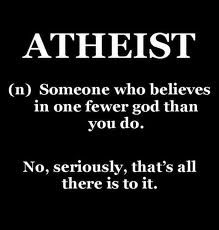 Back in September 2010 I addressed a clever rhetorical gem that has become quite popular among atheists. It’s what I’ve come to call the “one less God zinger.” It appears in several different forms, but could be summed up by the following representation: “We’re all atheists. Christians are atheists with respect to all gods but their own, while I am an atheist with respect to all gods, including your own. When you understand why you reject all other gods, you’ll understand why I reject all gods.”
I invited your criticisms of this zinger, and offered a couple of my own. Since then I have stumbled on other apologists’ response to it, allowing me to further develop my own. What follows is an updated evaluation and counter-responses.
April 18, 2011
Bertrand Russell and the Celestial Teapot
Posted by Jason Dulle under Apologetics, Atheism, Epistemology[2] Comments
 Once in a while I hear atheists bring up Bertrand Russell’s comparison of theistic belief to the belief that a teapot is orbiting the sun between Earth and Mars. Bill Vallicella has a nice post showing why this is a false analogy to theistic belief.
March 22, 2011
Peter Atkins, I thought it was all about the evidence?
Posted by Jason Dulle under Apologetics, Atheism, Logic, TacticsLeave a Comment
 Oxford professor of chemistry, Peter Atkins (atheist) recently engaged in dialogue with Oxford professor of mathematics, John Lennox (theist), on the question of God’s existence. While atheists such as Atkins often portray their atheism as being the result of being brave enough to follow the evidence to where it leads, at one point in the debate Atkins showed his true hand.
LENNOX: Do you think it’s an illegitimate thing from a scientific perspective…to see whether scientifically one can establish whether intelligence needs to be involved in the origin of life?
ATKINS: … Let’s just take the laws of nature as available. And seeing that, letting them run free in the environment that we can speculate existed…billions of years ago, and seeing whether that sort of process leads to life. And if it does, that seems to me to abrogate the need for the imposition of intelligence.
LENNOX: And if it doesn’t?
ATKINS: Then, if we go on trying (we may have to try for a hundred years), and if in the end we come to the conclusion that an external intelligence must have done it, then we will have to accept that.
LENNOX: Would you be prepared to accept that?
January 17, 2011
God’s Existence Can Be Disproven
Posted by Jason Dulle under Apologetics, Atheism, Theism[35] Comments
I often hear both non-theists and theists alike say it is impossible to disprove God’s existence because it is impossible to disprove a universal negative. This conception, though popular, is mistaken.
While a universal negative cannot be proven empirically, it can be proven logically. If something is logically contradictory, or incoherent, we can be sure it does not exist. For example, I can prove there are no square circles. I cannot, and need not do so empirically, but I can do so logically. To prove that God does not exist, then, does not require omniscience so long as one can demonstrate that there is something in the very concept of God that is rationally incoherent. Of course, that is difficult for atheists to do because there doesn’t seem to be anything about the idea of a divine, transcendent being that is internally incoherent or self-contradictory. Nevertheless, if they could find one, they could disprove God’s existence.

 Thinking to Believe