 Most people would define a hypocrite as someone who does something that they claim is wrong. That can’t be the right definition, however, because it would consign everyone to being a hypocrite. Everyone sins, which means everyone who believes in morality acts in ways that is contrary to morality. That would make everyone a hypocrite. If your definition of hypocrite turns every person into a hypocrite, then your definition is not a meaningful definition. Something is wrong with the definition. A hypocrite is not someone who fails to live up to their moral ideals, but someone who falsely professes to believe in such ideals in the first place. A hypocrite is an actor.
See also:
“I’m not a Christian because there are too many hypocrites in the church”
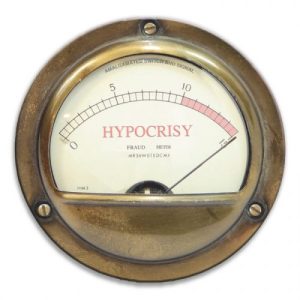 People often misunderstand and misapply the term “hypocrite.” A hypocrite literally refers to an actor. They are pretenders. In the realm of morals, a hypocrite is someone who pretends to be moral. They tell you not to do something, but have no intention of following their own commands. They are people who do not think their own rules apply to them. They might pretend to keep these rules, but secretly they flout them.
 If you think “God just wants me to be happy,” you are going to be very disappointed in your Christian life, and inclined toward sin and doubt. False expectations never end well.
 We are saved by faith, not works, but the faith that saves is a faith that works. True saving faith will produce good works. Faith, not works, is the causal condition for salvation, but good works are the necessary effect of our saving faith. That doesn’t mean we will be perfect, but it does mean we will be moving toward perfection via the process of sanctification.
 Our biggest temptation as humans is works righteousness – thinking that we can earn our salvation by own goodness. Ask the average nominal Christian in America how he knows he is saved and you’re likely to hear, “Well, I’m a pretty good person.” Even those who recognize that they are saved by grace alone often feel the temptation to believe they are “kept,” at least in part, by their good works. While we are certainly saved for good works (Eph 2:8-10; Tit 2:11-12), good works cannot save us or keep us saved. Our trust in Jesus alone saves us. Faith causes salvation – good works are the effect.
 Many people, both Christian and non-Christian alike, define God in terms of just one attribute – love – to the neglect of all other attributes. And even then, they misunderstand love to mean unqualified acceptance and approval of our behaviors rather than God’s unqualified desire for our good as a person. As a result of this misunderstanding of God’s nature and His love, people question the existence of hell, the legitimacy of moral judgments, etc. Yes, God is love, but He is so much more. He is also just and holy.
 Evangelism is scary for many people, including myself. Many Christians find it difficult to start a discussion on spiritual things. Others fear that they’ll be pummeled with objections to the faith that they don’t know how to answer. Many fear rejection. As a result, we’ve invented new methods of “evangelism” that don’t require us to actually talk to anyone. I’m thinking of “friendship evangelism” and “love evangelism” in particular.
 John Piper




 Thinking to Believe