 I am reminded of your sincere faith, a faith that dwelt first in your grandmother Lois and your mother Eunice and now, I am sure, dwells in you as well. 6 For this reason I remind you to fan into flame the gift of God, which is in you through the laying on of my hands, 7 for God gave us a spirit not of fear but of power and love and self-control. (2 Timothy 1:5-8, ESV)
What is the “gift of God” that Paul enjoined Timothy to fan into flame? Many interpreters, including Pentecostals, tend to view this gift as the gift of the Holy Spirit that we see in the book of Acts. I’ve heard a number of messages about stirring up the Holy Spirit inside of me, based on this verse. It’s not hard to see the connection. The laying on of hands is associated with receiving the gift of the Holy Spirit in Acts 8:17-18 and 19:6, and this experience is intimately connected with “power” being given to the believer (Luke 24:49; Acts 1:8; 4:33; 6:8; 10:38).
While this is a plausible interpretation, I do not think it is the best. Let’s consider other possibilities. (more…)
 If you think “God just wants me to be happy,” you are going to be very disappointed in your Christian life, and inclined toward sin and doubt. False expectations never end well.
 I am temporarily reviving an old series I did on hermeneutics called “straight outta context.” For this installment, I want to look at 1 Corinthians 3:10-17.
 In John 20:21-22, during Jesus’ first resurrection appearance to the apostles, He said, “’Peace be with you. As the Father has sent me, even so I am sending you.’ And when he had said this, he breathed on them and said to them, ‘Receive the Holy Spirit.'” Did the apostles receive the Spirit at that moment, or did the fulfillment of Jesus’ words await the Day of Pentecost (Acts 2:1-4)?
 More than 80 fragments of Nahum and Zechariah (not all have text written on them) were recently discovered in the Judean desert. These are the first Dead Sea Scrolls discovered in 60 years. Apparently, these fragments belong to a scroll of the Minor Prophets that was discovered in this same cave more than 60 years ago. That scroll, and these new fragments, are written in Greek rather than Hebrew. One of the interesting features of this scroll is that the name of God is written in paleo Hebrew, which is the ancient Hebrew script. Hopefully more scrolls will soon be discovered.
 Why doesn’t God give people a second chance to be saved after death (Heb 9:27)? Surely those who go to hell would want to repent once they are faced with the consequences of their sin, right? Wrong. This idea underestimates these people’s disposition toward God. They know God exists (Ps 19:1-4; Rom 1:18-32; 2:12-16), but they hate Him and refuse to acknowledge Him by repenting of their sins (Ps 83:2; Jn 3:20; 7:7; 15:18,23-24; Rom 1:30; Rev 9:20; 16:9,11). They reject His moral authority over their lives. While they do not like their punishment, they don’t want the alternative either. They don’t love God, and they don’t want to be with Him for eternity. It’s not so much that God will not give them a second chance to repent as it is that they would not take Him up on His offer if He were to give it.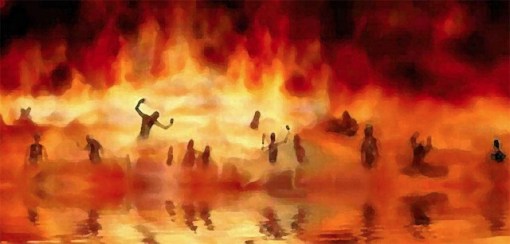
 We are saved by faith, not works, but the faith that saves is a faith that works. True saving faith will produce good works. Faith, not works, is the causal condition for salvation, but good works are the necessary effect of our saving faith. That doesn’t mean we will be perfect, but it does mean we will be moving toward perfection via the process of sanctification.
 Our biggest temptation as humans is works righteousness – thinking that we can earn our salvation by own goodness. Ask the average nominal Christian in America how he knows he is saved and you’re likely to hear, “Well, I’m a pretty good person.” Even those who recognize that they are saved by grace alone often feel the temptation to believe they are “kept,” at least in part, by their good works. While we are certainly saved for good works (Eph 2:8-10; Tit 2:11-12), good works cannot save us or keep us saved. Our trust in Jesus alone saves us. Faith causes salvation – good works are the effect.
 Sometimes we portray Jesus as providing us with a ladder to bridge the chasm between our sinful selves and a holy God. Jesus made a way for us to reach God. This is inaccurate. Jesus didn’t just provide us with a ladder and tell us to climb, but Jesus provided the ladder and climbs it for us. We get to the top – not by climbing it ourselves – but by riding on the back of Jesus.
 For a number of years now, churches have latched on to the “leadership training” fad. The idea is that everyone is a leader, and needs to be trained as such to be more effective in the kingdom. Really? Is everyone a chief? If so, where are the Indians? Those who claim everyone is a leader have to have a pretty thin definition of leader. Yes, everyone has influence in someone else’s life at some point, but that does not make them a leader or require that they undergo leadership training.
 Many so-called prophets had prophesied that Trump would win re-election, including Kris Vallotton, Jeremiah Johnson, Pat Robertson, Curt Landry, Tomi Arayomi, Kat Kerr, Denise Goulet, Charlie Shamp, Albert Milton, Taribo West, Kevin Zadai, and many more (references are in the comments). President Trump’s legal challenges to the election results have failed and the Electoral College has voted for Joe Biden to be the next president, so it should be abundantly clear at this point that Trump is not going to serve another four years.
 Certainty is a state of mind. One who is certain is one who does not doubt that some X is true. Having certainty regarding X does not guarantee that X is true, but merely that one believes X is true and has no doubts regarding its truth. Someone who seeks certainty regarding some X, then, seeks to justify belief in X to such a degree that they no longer have doubts regarding the truth of X.
 People’s perception of Christianity is often shaped more by their church experience than by Scripture. If your experience of Christianity was in a Catholic church, you may think of Christianity as solemn and reverent, but ritualistic and largely irrelevant to daily life. If your experience of Christianity was in a Baptist church, you may think of Christianity in terms of moral behavior and Bible study. If your experience of Christianity was in a Pentecostal church, you may think of Christianity as wild and crazy, where emotions and the supernatural are top priority. Whatever your experience may have been, that is what you associate with “Christianity.” For you, that IS Christianity.
 Sometimes we are damned if we do and damned if we don’t. Let me give you two examples where Christians cannot seem to win with non-Christians.
 Many people, both Christian and non-Christian alike, define God in terms of just one attribute – love – to the neglect of all other attributes. And even then, they misunderstand love to mean unqualified acceptance and approval of our behaviors rather than God’s unqualified desire for our good as a person. As a result of this misunderstanding of God’s nature and His love, people question the existence of hell, the legitimacy of moral judgments, etc. Yes, God is love, but He is so much more. He is also just and holy.

