 A hypocrite is not one who fails to live up to his own ideals, but one who falsely proclaims to have such ideals in the first place.
See also “I’m not a Christian because there are too many hypocrites in the church“
April 29, 2020
A hypocrite is not one who fails to live up to his own ideals, but one who falsely proclaims to have such ideals in the first place.
See also “I’m not a Christian because there are too many hypocrites in the church“
February 10, 2020

As Christians, we want to know and do God’s will, but many Christians struggle to hear God’s voice and know His will. They find the whole process frustrating and vague, and they are left feeling spiritually paralyzed. Could it be that the problem does not lie with God’s silence nor our inability to hear what God is saying, but with our conception of God’s will and the particular methods we use for discerning it? Could it be that our conception of God’s will and hearing His voice is not taught in the Bible? Perhaps we have over-complicated and over-spiritualized the will of God.
Many Christians think God’s will for their life is both extensive and detailed. In addition to God’s general will that we develop our moral character, He also has a more specific will for us concerning our education, our vocation, our residency, our spouse, where we congregate, and other matters big and small. Our job is to (1) discern God’s will in these matters using various methods such as a peace in our heart, open and closed doors, unbidden thoughts, impressions, signs, and fleeces, and then (2) make choices that match God’s will. The process is similar to navigating: God chooses our destination and the route we should take to get there, and our job is merely to discover the map and follow it turn-by-turn.
This sounds reasonable and perhaps even comforting, but is it Biblical? I assumed so, until I was forced to look at Scripture more carefully. Now, I’m convinced that this understanding of the will of God – while well-intentioned – errs in its assumptions about (1) the extent of God’s will and (2) the methods for discerning it. (more…)
January 16, 2020
 Evangelism is one of the most important missions of the church. In evangelism, we are making an appeal to non-Christians to both believe and do something. What we ask them to believe and do ought to pattern what the first disciples asked non-Christians to believe and do. Does it? To answer that question, I recently examined what the early church preached to unbelievers, chronicling every detail of every message found in Acts (2:14-40; 3:12-26; 4:8-12,33; 5:29-32,42; 7:2-53; 8:5,12,35; 10:34-43; 11:20; 13:16-41; 14:15-17; 16:30-31; 17:2-3,6-7,18,22-31; 18:5,28; 19:2-4,8; 20:21,25; 22:1-21; 23:6,11; 24:10-21,24-25; 25:19; 26:1-23; 28:17-20,23,30).[1] What follows are my findings and analysis. (more…)
September 5, 2019
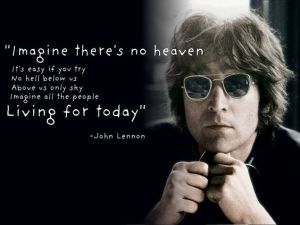
Would you still be a Christian if there was a heaven, but no hell?
Imagine for a moment that God set up reality differently, such that people could be as bad as they wanted without any risk of eternal punishment. When you die, you simply cease to exist. However, if you follow Jesus, heaven still awaits you. Would you still follow Jesus? Be honest. I encourage you to take five minutes to reflect on this question before reading on below.
August 19, 2019
 Evangelism is scary for many people, including myself. Many Christians find it difficult to start a discussion on spiritual things. Others fear that they’ll be pummeled with objections to the faith that they don’t know how to answer. Many fear rejection. As a result, we’ve invented new methods of “evangelism” that don’t require us to actually talk to anyone. I’m thinking of “friendship evangelism” and “love evangelism” in particular.
The premise of friendship evangelism (also known as relationship evangelism or lifestyle evangelism) is that people will be attracted to your way of living (your holy behavior, your happiness, how you treat others, etc.), prompting them to ask you what your secret is, and predisposing them to become a Christian. At that point, you share the gospel with them.
May 13, 2019
We tend to define backsliding as a believer reverting to a life dominated by sin, but I think a better definition of backsliding is simply when we lose spiritual ground that we had achieved previously.
April 21, 2019
The resurrection of Jesus is central to the Christian faith, but why does it matter? Why think of it as just another of many miraculous/supernatural events? Why not see it as a mere historical oddity? Why does it matter so much to Christianity? What is the significance of Jesus’ resurrection from the dead?
Here are just a few reasons it is significant:
April 21, 2019
 The resurrection of Jesus Christ from the dead was the central message of the early church and the basis of Christian hope. But why should we believe that a man was raised from the dead 2000 years ago when we were not there to witness it, and when our uniform experience says that dead people always stay dead? While many people think the resurrection of Jesus is something you either choose to believe or choose to reject based on your personal religious tastes, the fact of the matter is that there are good, objective, historical reasons to believe that Jesus rose from the dead.
Historians must do two things: establish the historical facts, and then find the best explanation for those facts. When it comes to the life of Jesus, the primary source material for the historian is the New Testament (NT) gospels and Paul’s writings because they include the testimony of early disciples who witnessed the events in question or knew those who did, and they provide the most detail about Jesus’ life.
March 9, 2019
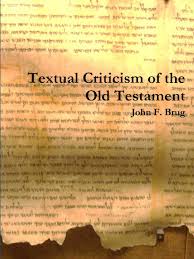 While there is much discussion regarding the fidelity of the transmission of the NT text, very little attention is given to the OT. I’ve long been looking for a good book dedicated to OT textual criticism, written from the perspective of a conservative text critic, so I was happy to come across John F. Brug’s Textual Criticism of the Old Testament.
Brug does a great job of explaining the manuscript resources, how text critics go about establishing the original text, ancient and modern criticism of the text, and many examples of the variants with a fair assessment of which are original. What I was particularly interested in is his explanation of the differences between the Greek translation and the Hebrew, as well as the differences in names and numbers in parallel passages such as Kings and Chronicles.
The book is under 200 pages, so it’s very digestible. I would highly recommend this as an intermediate introduction to OT textual criticism.
January 21, 2019
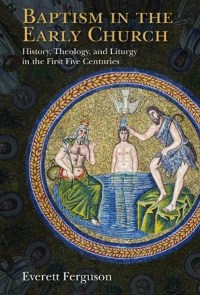 I recently finished Everett Ferguson’s Baptism in the Early Church. This massive tome of 860 pages thoroughly explores the theology and practice of baptism in the first five centuries of the church. What follows is a brief summary of Ferguson’s main findings.
Origins
Baptism was a big deal to the early Christians. It was modeled on John’s practice, as well as Jesus’ example and command. Unlike Jewish and pagan precursors which saw ritual washings as related ritual purification, Christian baptism was intended for spiritual cleansing and moral transformation.
Ceremony
Great pomp and ceremony developed very early around the church’s practice of baptism. While traditions differed from region to region as well as over time, in general, baptism was performed in the nude, via triple immersion, with the laying on of hands, exorcisms, renunciation of the devil, anointing with oil, confession of the creed, post-baptismal eucharist, and the wearing of a white garment. (more…)
January 7, 2019
 In the parting words of Paul’s first letter to the church at Thessalonica, he admonished them with several imperatives, including “pray without ceasing” (1 Thes 5:17).
Many Christians have struggled to make sense of Paul’s admonition because it’s evident that we cannot literally pray without ceasing. At the very least, we would have to stop praying when we go to sleep at night. Even if Paul was only talking about our conscious hours, one cannot pray while they are talking to other people, concentrating on their work, etc. Many Christians, wanting to affirm the sense of “continual prayer,” have taken this verse to mean that we should continually be in “a spirit of prayer.” This is often construed along the lines of always having a prayerful attitude even when we are not praying to God (which should be a frequent affair throughout one’s day). What exactly a prayerful attitude is, is not entirely clear. Others take it to mean that we should pray about everything.
December 4, 2018
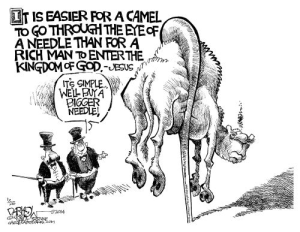 Jesus said, “It’s easier for a camel to go through the eye of a needle than for a rich person to enter the kingdom of God” (Mt 19:24; Mk 10:25; Lk 18:25). Jesus said this after the young rich ruler refused Jesus’ call to discipleship because he was unwilling to give away all of his riches. Jesus’ point seems to be that people with wealth tend to trust in their wealth, making it difficult for them to place their trust in Christ.
This doesn’t make much sense on a Calvinistic view of salvation, and thus serves as evidence against Calvinism.
March 6, 2018
 We often speak of the need to “forgive yourself.” While I understand what is meant by this phrase, it is unintelligible on the Christian worldview. People speak of the need to forgive themselves in the context of feeling guilt for something they did (or failed to do). They recognize the need to eliminate this guilt and get on with their life – to stop beating themselves up for their failure.
The problem with this notion is that it’s not possible to forgive oneself. Forgiveness is something only a third party can grant to you. You can no more forgive yourself than you can give something to yourself. On the Christian worldview, the ultimate source of our forgiveness is God Himself. We will never stop feeling guilt if we are looking to ourselves. The solution for guilt is not self-forgiveness, but divine forgiveness. If we continue feeling guilt after we have repented of our sin, that is evidence that we have not truly believed that God has forgiven us – because once God forgives and we believe He has forgiven, the conscience ought to be quieted (Heb 9).
January 9, 2018
 In the past I offered a general Christian creed written from a Oneness perspective. Here is another creed I wrote specifically articulating Oneness theology:
I believe in one God, eternal and almighty,
creator of heaven and earth;
Both one in essence and one in person;
Who for us became one of us, and yet remained God;
One person in two natures, both divine and human;
The eternal God who became temporal man.
I believe in Jesus Christ, God incarnate;
Son of God and son of Adam;
Who took on our nature to take away our sin;
Divine by identity and human by function,
he rescued us as one of us, dying in our stead;
Raised from death to die no more,
In whom we confidently wait for the same, amen.
November 8, 2017
Part of our theodicy for the problem of evil includes the point that it was logically impossible for God to create a world in which humans enjoyed free will (a good thing), and yet were unable to use that freedom to choose evil as well as the good. I accept that as true, and yet Christianity proclaims there is coming a day in which there will be a world consisting of humans with libertarian free-will, who will never choose evil: heaven. The future hope of Christians seems to undermine one of the central premises in our theodicy. Can this be reconciled?
Some have suggested that we will not sin in heaven because we’ll be in the beatific presence of God. Presumably, the angels exist in the beatific presence of God, and yet many of the angels chose to rebel against God in that state. This alone, then, cannot explain why humans won’t sin in heaven.
Others have suggested that we will not sin in heaven because God will glorify our humanity. But this is not a solution; it is an admission of the problem. Glorification is being put forward, not to show that such a world cannot exist, but rather to explain how it will become a reality. If in the future God is able—through glorification—to make human beings such that they have free will, and yet will not choose evil, then it falsifies the claim that God cannot create a world in which humans enjoy libertarian free will, and yet never choose evil. Indeed, He will do so in the future. In light of such, we might ask why God did not do this from the onset. Why didn’t He create humans in a glorified state to begin with, if glorified humans can exercise free will and yet not choose evil?
September 22, 2017
 Skeptics of Christianity often try to undermine the truth of Christianity by pointing to supposed errors or contradictions in the Bible. As a result, some Christians have abandoned the faith, while others remain shaken in their faith. This is unfortunate because the skeptics’ approach is fundamentally flawed.
We must distinguish between what makes Christianity true (an ontological question) and how we know Christianity to be true (an epistemological question). Many people think it’s the Bible that makes Christianity true. That’s why they question the truth of Christianity when they are confronted with supposed errors or contradictions in the Bible. A moment’s reflection reveals this to be wrongheaded. After all, couldn’t God have chosen to communicate the Gospel truths orally rather than in a written format? Of course! Indeed, that’s how it was transmitted in the early church. If Christianity could still be true without any written Bible at all, then surely it could still be true even if the Bible contains errors.
August 22, 2017
 If God knows every choice we’ll make from eternity past, doesn’t that mean our choices are not free – that God has caused us to do what we do? No. Knowledge is not a cause. Knowing what someone will choose to do in advance of their actually doing it does not cause them to do it. While it’s true that if God knows X will happen, X will most certainly happen, but it’s not God’s knowledge of X that makes X happen. It’s our choice to do X. God merely knows what we will freely choose in advance. While God’s knowledge is chronologically prior to our acts, our acts are logically prior to God’s knowledge. If we would have chosen A rather than B on October 12, 2006, God would have known A rather than B. The reason He knew B would happen from eternity past is because He knew we would freely choose B from eternity past. God’s foreknowledge does not determine our choices, but is informed by our choices. In other words, God’s foreknowledge is not the cause of our actions; our actions are the cause of God’s foreknowledge.
July 10, 2017
 While there are a number of arguments for the existence of a divine being, none of them require that there be only one divine being. Why should we think there is only one God, then?
The simplest reason to think there is only one God is the principle of parsimony: Do not multiply entities beyond what is needed to adequately explain the effect in question. Since only one God is needed to explain the origin of the universe, there is no reason to believe there is more than one God. The burden of proof would be on anyone wanting to postulate the existence of more than one God to explain why we should think there is more than one God.
While the principle of parsimony is instructive, it is not conclusive. It is based on probability, not logical necessity. It’s one thing to say no more than one God is necessary to explain reality, but that doesn’t necessarily mean there is only one God. After all, only one human is needed to explain how a house got built, but the fact of the matter is that more than one human was involved. So are there any logical arguments that would logically require the existence of only one God?
June 27, 2017
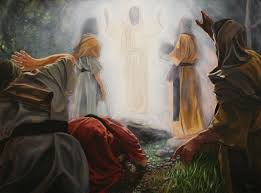 Only the resurrection of Jesus from the dead can explain why Christians believed Jesus was divine. It also gives credence to the fact that Jesus claimed to be God.
Many skeptics think that Jesus never made claims to deity – that such claims were merely put on his lips by his followers. But why would they do so? The Jews had no concept of a divine messiah. Indeed, the idea that God could become a human being was considered blasphemy to the Jews. If the gospels are to be believed, the reason Jesus was condemned to death by the Jews was precisely because he claimed to be God.
May 19, 2017
 Could the human population have originated from two people? Many say science has proven this to be impossible and are reinterpreting the Biblical narrative to fit the current scientific thinking. In this article, Fuz Rana evaluates the science behind the claims regarding original human population sizes. He notes that it is based on mathematical modeling rather than empirical data, and those mathematical models have failed verification in each case we have been able to test them. At the very least this ought to give Christians pause before reinterpreting the Bible to fit the latest scientific thinking. It would be foolish to abandon the historicity of a primordial pair of humans based on scientific reasoning that has inaccurately “predicted” the original population sizes of animals for which we know the original populations. If the mathematics are too idealized for real-life biology, then Christians should not feel the pressure to “revise” our theology.
 Theosophical Ruminations
