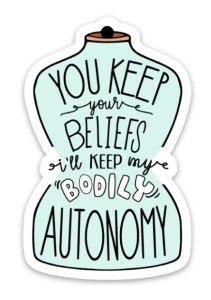
 In the abortion debate, pro-choice advocates often argue that no one should have the right to tell a woman what to do with her own body. I agree. No one has that right. But this is a red herring because pro-life advocates are not telling women what to do with their own bodies, but rather what to do with someone else’s body.
While an abortion takes place within a woman’s body, the act of abortion is targeted toward the body of a separate human being. The goal of abortion is to end the life of that human being – often by cutting his/her body into pieces. Since it is morally wrong to take the life of an innocent human being, the act of abortion is morally evil.
The bodily autonomy argument makes as much sense as saying “You don’t have a right to tell me not to murder someone.” All homicide laws aim to take away our right to murder another person. Pro-life advocates are merely applying this same logic to abortion since the object of the abortion is also a human being.
 Here’s a question to ponder: How many of the positions that you subscribe to today related to theology, economics, politics, etc., do you subscribe to because you researched the competing perspectives, weighed the merits and demerits of each, and then adopted the best position? If you are a typical human being, chances are that the number is very small. Most of the positions we subscribe to we simply inherit from our family or community, unquestioned. When we do question those positions, we often seek out evidence to shore up what we already believe rather than seeking evidence both for and against our position. Given this proclivity of human nature, and given the multiplicity of positions, there’s a high probability that we are mistaken in a number of positions we subscribe to. After all, it would be highly unlikely that one just happened to be born into a family/community who just so happened to subscribe to all of the right positions in theology, politics, economics, and the like.
 Evangelism is scary for many people, including myself. Many Christians find it difficult to start a discussion on spiritual things. Others fear that they’ll be pummeled with objections to the faith that they don’t know how to answer. Many fear rejection. As a result, we’ve invented new methods of “evangelism” that don’t require us to actually talk to anyone. I’m thinking of “friendship evangelism” and “love evangelism” in particular.
 Theists argue that God is the best explanation for objective moral truths. Atheists typically appeal to the Euthyphro Dilemma (ED) to show that God cannot be the foundation for morality. The ED asks whether something is good only because God wills it as such, or if God wills something because it is good. If something is good only because God considers it good, then goodness seems arbitrary and relative to God’s desires. If He had so chosen, murder could have been right and truth-telling could have been wrong. On the other hand, if God wills the good because it is inherently good, then goodness would be a standard that exists outside of God. He is subject to the moral law just as we are.
 When something bad happens, it’s common for people to offer the encouragement that “everything happens for a reason.” Is it really true, however, that everything that happens, happens for a reason? To answer that question we need to explore what we mean by “everything,” “for” and “reason.”
 The resurrection of Jesus Christ from the dead was the central message of the early church and the basis of Christian hope. But why should we believe that a man was raised from the dead 2000 years ago when we were not there to witness it, and when our uniform experience says that dead people always stay dead? While many people think the resurrection of Jesus is something you either choose to believe or choose to reject based on your personal religious tastes, the fact of the matter is that there are good, objective, historical reasons to believe that Jesus rose from the dead.
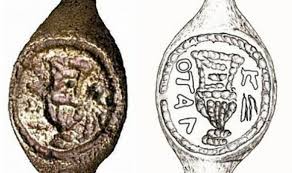
 Another clay seal (bulla) bearing the name of a Biblical person has been unearthed in the City of David. The tiny clay seal was found in the remains of a large housing structure that had been destroyed by fire in the sixth century B.C. The seal reads, “[belonging to] Nathan-Melech, Servant of the King.” Nathan-Melech appears once in the Bible, in 2 Kings 23:11, and is said to be an official in the court of King Josiah.
  While there is much discussion regarding the fidelity of the transmission of the NT text, very little attention is given to the OT. I’ve long been looking for a good book dedicated to OT textual criticism, written from the perspective of a conservative text critic, so I was happy to come across John F. Brug’s
 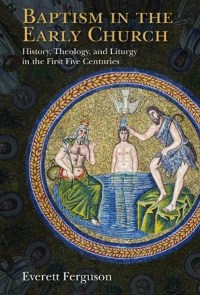 I recently finished Everett Ferguson’s
  In the parting words of Paul’s first letter to the church at Thessalonica, he admonished them with several imperatives, including “pray without ceasing” (1 Thes 5:17).
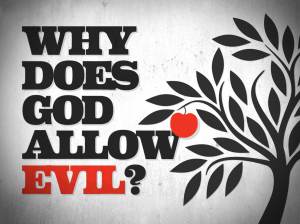 Probably the most-cited argument against the existence of a theistic God is the logical form of the problem of evil, which argues that the existence of an all-good and all-powerful God is logically incompatible with the existence of evil because an all-good God would want to prevent evil and an all-powerful God could prevent evil, and yet evil exists. From this, it follows that God is not all-powerful, not all-good, or more likely does not exist at all. There could be a world in which God exists, or there could be a world in which evil exists, but there can be no world in which both God and evil exist. Since it’s empirically evident that evil exists, God does not.
 A few weeks ago, a
 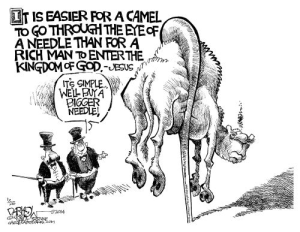 Jesus said, “It’s easier for a camel to go through the eye of a needle than for a rich person to enter the kingdom of God” (Mt 19:24; Mk 10:25; Lk 18:25). Jesus said this after the young rich ruler refused Jesus’ call to discipleship because he was unwilling to give away all of his riches. Jesus’ point seems to be that people with wealth tend to trust in their wealth, making it difficult for them to place their trust in Christ.
 A 69 year old Dutch man, Emile Ratelband, is


 Thinking to Believe