We rightfully bemoan the rise of the gay hermeneutic in which Christians are reinterpreting the Bible to allow for committed same-sex relationships, but has anyone ever stopped to think that what these liberals are doing to the homosex texts we “conservatives” have already done to the divorce and remarriage texts? We have mangled Jesus and Paul’s teachings to allow for divorce for reasons other than sexual immorality, and to allow those who have divorced or have been divorced without grounds to remarry because we don’t think it is fair for people to be unhappy or alone. We understand the strong desire to be in a loving, sexual relationship. Our emotions become the motivating factor for reinterpreting (or ignoring) what would otherwise seem to be a pretty straightforward condemnations for most divorces and remarriages.
May 18, 2015
Divorce/remarriage and the approval of same-sex relationships rely on the same hermeneutic
Posted by Jason Dulle under Apologetics, Bible, Hermeneutics, Homosexuality, Same-sex Marriage, Theology[40] Comments
May 14, 2015
Are All Christological “Heresies” Truly Heretical?
Posted by Jason Dulle under Christology, Theology[76] Comments
 “Heresy” is a word that gets thrown around rather loosely these days. We will cavalierly declare someone a heretic because their views on eschatology differ from our own. It’s famously been said that “heresy is what you believe, while orthodoxy is what I believe.” But heresy is not the same as error. Not all theological errors or false doctrines rise to the level of heresy. A heresy is a belief held by a confessing Christian that is sufficient to damn their soul. To charge someone with heresy is not merely to say that their theology is wrong, but that it is so wrong that they do not qualify as a Christian and are not saved.
May 8, 2015
 Jesus charged his apostles – and by extension, his church – with the great commission. The mission he gave us involves both the proclaiming of the gospel as well as the discipling of those who put their trust in Jesus.
If we are honest with ourselves, the American church is not great at either proclaiming or discipling, but we are doing worse on the proclaiming end, and it’s only getting worse. As our culture becomes increasing secular and as Christians increasingly buy into the notion that our faith is to be kept private, we are becoming increasingly reluctant to proclaim Jesus. There are a host of reasons for this, but I am not concerned to analyze them at this point. Instead, I want to focus on the type of evangelism we are opting for in its place. Some have called it “lifestyle evangelism.” Lifestyle evangelism entails the notion that the way we live our life is the best witness of Jesus. Our lives are a living gospel. This form of evangelism is summed up in the apocryphal quote attributed to Francis Assisi: “Preach the gospel. If necessary, use words.”
May 6, 2015
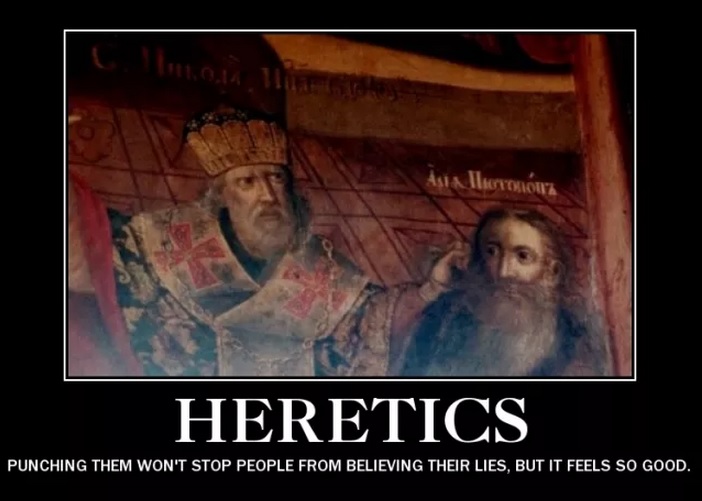
The mythical being we call Santa Claus or “St. Nick” is loosely based on a real historical figure, Saint Nicholas of Myra. St. Nicholas served as the bishop of Myra in the early fourth century. While he is known as a giving man, most do not realize that he gave people more than money.
The story goes* that he was one of the bishops present at the Council of Nicea in A.D. 325, and was a defender of the full deity of Christ against Arius. When Arius took the floor and began to argue for his view of Jesus (a view that claimed Jesus was a created divine being who was less than fully God), Saint Nicholas’ heresy meter went off…as well as his temper. He entered the “ring” and proceeded to slap Arius in the face for speaking such heresies.
So next the next time you think of Santa Claus, don’t think of the jolly ‘ol fat man in the red suit; think of the fist-fighting defender of orthodoxy! Take that…and that…and that you heretics!
BTW, legend has it that when Nick slapped Arius, Arius yelled out “Ho ho homoousios.” If you didn’t get that, don’t worry. Just a stupid theology joke.
*I have to admit that there are not good historical grounds for the story. St. Nick is not mentioned as being present in the contemporary historical sources, and the story about him punching Arius does not appear in any literature until the late 14th century. Furthermore, Arius wasn’t even allowed to speak at the council since he was not a bishop (Eusebius of Nicomedia defended Arius’ position for him at the council), so he couldn’t have slapped Arius. Despite the questionable historical veracity of the account, it’s just too fun to pass up.
May 2, 2015
Please tell us, counsel, why polygamy is not next?
Posted by Jason Dulle under Apologetics, Politics, Same-sex Marriage[10] Comments
There was an interesting exchange between Justice Alito and Mary L. Bonauto, one of the lawyers arguing on behalf of same-sex marriage before SCOTUS. Alito asks Bonauto how polygamous unions could be denied the right of marriage in the future if SCOTUS ruled in Bonauto’s favor given that the rationale offered for legalizing same-sex marriage seems to apply to polygamous unions as well. Bonauto’s response was…well…interesting. After shooting herself in the foot, the best she could come up with was a statement of faith that it wouldn’t happen due to some practical and legal concerns. Not very persuasive. The fact of the matter is that once you dispense with the opposite-sex prerequisite for marriage, the idea of “two and only two” no longer makes sense. The rational basis for limiting a marriage to two people is that there are two sexes, and the sexual completeness of one man and one woman. As Robert Gagnon has written: (more…)
April 28, 2015
What I’ve Been Reading: What Every Christian Needs to Know About the Qur’an
Posted by Jason Dulle under Book Reviews, Islam, Religions[21] Comments
 Islam is the second largest religion in the world, and growing rapidly. As such, it’s important for Christians to have a basic understanding of this formidable religion, and in particular, it’s sacred text, the Qur’an. Christian apologist, James White, has written an excellent book – What Every Christian Needs to Know About the Qur’an – that provides Christians with a basic understanding of the Qur’an, focusing on the topics that divide Muslims and Christians.
White begins the book by making a case for why Christians should concern themselves with the teachings of the Qur’an. From there, he provides a broad overview of both Muhammad and the Qur’an:
- A brief sketch of Muhammad’s life and the origin of Islam
- According to Muslims, the Qur’an was written by God from eternity past and merely dictated to Muhammad by an angel over a period of 22 years. As such, it is inerrant.
- The central tenet of faith for Muslims is the absolute numerical oneness of God (tawhid), and a confession that Muhammad is His greatest and last prophet.
- The worst of all sins is to associate anything with God (shirk), so the Christian claim that Jesus is God is shirk.
While White’s book is not written as a refutation of the Qur’an’s claims to be divine revelation, there are a number of points raised in the book that expose the Qur’an’s claims as false:
April 12, 2015
If you know God exists, you are an atheist?
Posted by Jason Dulle under Apologetics, Atheism, Atheistic objections, Epistemology, Logic, Tactics[74] Comments
Christian apologist, Tyler Vela, has observed that atheists like to define “atheism” and “belief” in very nontraditional ways, and these definitions lead to an absurdity. Consider the following: “Atheist” is redefined as someone who merely lacks the belief that God exists (rather than someone who believes God does not exist), and “belief” is redefined as holding something to be true without evidence (rather than a mental disposition concerning the truth of some proposition). Given these definitions, if God did something by which all people had direct and incontrovertible evidence that He existed, then no one could believe in God (since His existence is no longer an opinion without evidence). If no one believes in God because they know God exists, then they are atheists (because atheists lack a belief in God’s existence). Ironically, then, everyone would be an atheist precisely because they know God exists.
April 7, 2015
Muslim bakeries refusing same-sex wedding cakes
Posted by Jason Dulle under Apologetics, Ethics, Fun, Political Incorrectness, Same-sex Marriage[4] Comments
In light of my recent post regarding religious freedom, Lowder with Chowder has a great video talking about this issue. He illustrates it by showing what happens when a supposedly homosexual man asks a number of Muslim bakeries to bake him a same-sex wedding cake. The end is great too. He addresses the idea that people should not go into business unless they have no conscience or are willing to violate their conscience are willing to provide their services for any purpose.
April 6, 2015
The sociology of cohabitation: “Shacking up” isn’t such a good idea after all
Posted by Jason Dulle under Holiness, Sin, Social[14] Comments
 Cohabitation – the politically correct term for what used to be called “shacking up” – has become very common in our day. Nearly 8 million opposite-sex couples live together today, compared to less than 1 million 30 years ago. Nearly 10% of all opposite-sex couples are cohabiting, and over half of all first marriages are preceded by a period of cohabitation.
How did we get here?
How did cohabitation go from being illegal in all states prior to 1970 and held in moral contempt by society at large to being so ubiquitous and accepted today? There are several reasons:
- The sexual revolution removed the moral stigma of premarital sex.
- Our culture has moved from a culture of traditions and social conformity to a culture of individualism and personal gratification.
- We shifted from a deontological view of morality to a pragmatic and relativistic view of morality in which any activity that does not cause harm to others is morally permissible.
- The recognition of the fragility of marriage, and a corresponding fear of divorce.
- The rise of feminism which rejected the traditional roles played by married women. Cohabitation promised personal autonomy and more relationship equity.
- The increasing economic independence of women made marriage less necessary for them. And men, who are generally more fearful of commitment, supported the arrangement since it still provided for their needs of sexual gratification and domestic support.[1]
Cohabitation is not what it seems
April 3, 2015
Why Moral Platonism Is Not a Good Explanation for Objective Morality
Posted by Jason Dulle under Apologetics, Moral Argument, Theistic Arguments[23] Comments
 Virtually all moral theories end up with a subjective version of morality (including evolutionary explanations of morality), in which moral values have their genesis in the human will in one way or another. In our moral experience, however, we have a basic moral intuition that moral values are objective.
To say a moral value is objective is to say its truth value does not depend on any human knower. So, for example, to say that killing Jews simply because of their ethnicity is immoral in an objective sense is to say that killing Jews is wrong whether anyone believes it to be wrong or not. If Hitler had won the war and eliminated everyone that thought the Holocaust was immoral, such that everyone believed it was moral, it would still, in fact, be immoral.
April 1, 2015
Navy Chaplain May Be Terminated for Speaking Against Homosexuality
Posted by Jason Dulle under Apologetics, Homosexuality[9] Comments
March 31, 2015
The First Amendment be damned: Homosexual rights even trump Constitutional and basic human rights
Posted by Jason Dulle under Apologetics, Homosexuality, Political Incorrectness, Same-sex Marriage[7] Comments
For those who are reacting so negatively to the Indiana religious freedom law, do you not realize what you are saying (even if not explicitly)? You are saying that people should not have the right to live out their own religious convictions and follow their own conscience. Read that sentence again. Say it out loud. You are saying we should deny these American citizens a Constitutional right that is 200+ years old so that we can uphold these new same-sex marriage rights that are less than 10 years old and nowhere to be found in the Constitution. You would deny American citizens a basic human right (the free exercise of religion and conscience) in favor of a right we just made up a few years ago.
March 27, 2015
Christian ethics are, but Christianity is not…true
Posted by Jason Dulle under Apologetics, Ethics, Theology[41] Comments
Some people value Christian ethics, but deny that Christianity itself is true. This makes no sense. The truth of Christian ethics is directly dependent on the truth of Christian metaphysics. If Christian metaphysics are mistaken, then the ethics that flow from those metaphysics have no basis in reality (on the Christian worldview).
Granted, it could still be the case that Christian ethics are still true in toto or in part, even if Christian metaphysics is false. But in that case, they are true in virtue of the truth of some other metaphysical worldview or meta-ethical system. So why continue to embrace these ethics as CHRISTIAN ethics if their truth is grounded in something other than Christianity? It’s one thing to affirm that Christian ethics are true even if Christianity isn’t, but it’s another thing to subscribe to Christian ethics as CHRISTIAN ethics while denying that Christianity is true.
March 27, 2015
Indiana governor signs free exercise of religion bill
Posted by Jason Dulle under Apologetics, Homosexuality, Political Incorrectness, Politics, Same-sex Marriage[4] Comments
Indiana Governor, Mike Pence, has signed legislation that prevents anyone (individuals, business owners, organizations) from being forced to violate their conscience and religious convictions (what the bill calls “exercise of religion”). One would think the First Amendment of the U.S. Constitution would be enough to secure these rights, but not these days. While the historical context of the bill is surely recent examples in which business owners have been forced by state governments to offer their services to homosexuals in ways that violate their conscience and religious convictions, the bill does not make any reference to homosexuality in particular. It is a general protection religious freedom.
This bill will prevent Jewish publishers from being forced by law to print anti-Jewish propaganda, gay sign-makers from being forced to make signs that condemn homosex, and Christian business owners from being forced by law to provide services that violate their religious convictions. Like it or not, agree with it or not – that is true freedom of conscience and freedom of religion.
You can read the text of the law here. An excellent legal analysis can be found here.
March 25, 2015
Morality cannot exist if God exists?
Posted by Jason Dulle under Apologetics, Atheistic objections, Moral Argument, Theistic Arguments[38] Comments

Professor Garret Merriam argues that if God exists, then we can’t be moral. In other words, we can only be moral if morality is not grounded in God’s existence. This is a reversal of the moral argument for God’s existence. It’s a moral argument against God’s existence.
Like many new atheists, Merriam argues that the Christian God commands and commits evil, so if morality is rooted in God and our moral duties are based on God’s commands, morality is impossible. I don’t accept the premise that God commands or commits evil, but let’s grant it for the sake of argument. Does his conclusion follow? No.
March 16, 2015
What I’ve Been Reading: The Bible and Homosexual Practice – Texts and Hermeneutics
Posted by Jason Dulle under Apologetics, Homosexuality[46] Comments
 For more than three thousand years Jews and Christians have understood the Bible to condemn homosex in no uncertain terms. Today, however, we are witnessing the rise of a gay hermeneutic that reinterprets the Bible’s teachings on homosex in a way that allows for at least some forms of homosex. While small in number, this movement has a handful of reputable scholars making their case. So what does the Bible really say? Have we misunderstood the Bible on this issue for millennia, or are the Scriptures being twisted by those who want the Scriptures to affirm homosex for various personal or social reasons?
Robert Gagnon’s The Bible and Homosexual Practice: Texts and Hermeneutics is a must-read for everyone who want to know what the Bible has to say on this topic. Gagnon examines the relevant OT (creation, cursing of Ham, concubine, Sodom and Gomorrah, Leviticus, cult prostitutes, David and Jonathan) and NT texts in depth, the cultural background of the Ancient Near East (ANE), and classic arguments offered against homosex (focusing on the argument from anatomical complementarity and natural function). He finishes the book by interacting with arguments against the Bible’s enduring authority on this issue, showing how none of them are successful.
March 13, 2015
What I’ve Been Reading: The Soul – How We Know It’s Real and Why It Matters
Posted by Jason Dulle under Apologetics, Book Reviews, Dualism, Naturalism, Science, Theism, Theistic Arguments[17] Comments
 Until relatively recently, most people believed that human beings are constituted of both body and soul. With the rise of materialism, Darwinism, and neuroscience, however, this notion is under scrutiny and dismissed by most secular thinkers as ridiculous. The notion that humans have souls is tantamount to a “ghost in the machine,” as British philosopher Gilbert Ryle put it.
The existence of the soul is important to Christianity for a variety of reasons. First, the Scriptures teach that humans have souls. If we don’t, then Scripture is wrong. Second, if humans lack souls, then there is no life beyond the grave (at least prior to the resurrection). But apart from the Bible or human tradition, why should we think the soul exists? That is the subject of J.P. Moreland’s newest book, The Soul: How We Know It’s Real and Why It Matters.
This is not the first book Moreland has written on the subject, but it is the first book that is easily accessible to a lay audience. In less than 200 pages, Moreland lays out the case for the existence of the soul, the nature of the soul/consciousness, and the afterlife. He manages to examine the Biblical teaching on the topic as well.
While the modern tendency is to reduce the mind to the brain (appealing to neuroscience for empirical evidence), Moreland argues that this is manifestly false because mental properties are not identical to brain properties. If mental properties cannot be reduced to physical properties, then the mind is not a physical thing, but an immaterial substance.
March 9, 2015
Can evolution explain objective morality?
Posted by Jason Dulle under Apologetics, Atheistic objections, Moral Argument, Theistic Arguments[36] Comments
 There are two senses in which something can be considered good. Something can be good in a pragmatic sense: that which is the most effective means for obtaining some desired outcome. For example, if we desire to eat an ice cream cone without getting ice cream on our clothes, it is “good” to start eating from the top of the cone rather than the bottom. This kind of goodness is judged by something’s utility. It is considered good because it works well, and the human subject values the fact that it works well. We might call this kind of goodness “pragmatic goodness.”
Something can also be good in the sense that it has intrinsic moral virtue/character. For example, it is “good” to try to save someone who is drowning. This kind of goodness is judged by the intrinsic moral character of the act itself, rather than its utility. Indeed, risking one’s life to save a stranger has little utility for the rescuer, but great moral virtue nonetheless. This sort of goodness is not determined by what we desire or the value we attach to the outcome, but is rooted in the moral character of the act itself, wholly independent of what any human may think about it.[1] We might call this kind of goodness “moral goodness.” This is the kind of goodness moral philosophers have in mind when they talk about objective morality. (more…)
March 3, 2015
Will God Forgive Intentional Sin?
Posted by Jason Dulle under Forgiveness, Hamartiology, Holiness, Theology | Tags: forgiveness, unforgivable sin |[82] Comments
 Many Christians wonder whether God will forgive them for intentional sin – particularly premeditated and habitual sins. It’s easy to believe God will forgive us for accidental sins, but not for sins that we plan out in advance or choose to do over and over again.
So, will God forgive such sins? Before we answer that question we should be clear about what God thinks of these sins. He hates them because He hates all sin. Sin is contrary to His holy nature. Sin ruptures God’s relationship with us, and this grieves Him. He has given us the power to choose righteousness (Romans 6; 8:1-4) and yet we choose unrighteousness instead. (more…)
February 27, 2015
No NT Promise that Jesus Would Come “Soon”
Posted by Jason Dulle under Eschatology, Theology[9] Comments
 Ben Witherington III has argued that references to Jesus returning “soon” are based on a mistranslation of en taxei. Rather than referring to when Jesus will come (soon), it refers to how Jesus will come when He does (quickly). This is important to claims that the NT teaches that Jesus was expected to return in the first century, or the expectation of a pre-tribulation return of Christ.
___________________
[1]Ben Witherington III, “’En Taxei’ – Quickly or Soon?”; available from http://www.patheos.com/blogs/bibleandculture/2015/01/25/en-taxei-quickly-or-soon/; Internet; accessed 17 February 2015.

 Thinking to Believe