Posting has been quite infrequent, especially of late. My explanation is the same as before. Things are finally letting up a bit at work now, and perhaps I’ll finally be able to get back to blogging on a regular basis and respond to the massive number emails that have been piling up in my inbox over the last few months (sorry Facebook and Twitter, but I’ll never get caught up on you). Thank you, everyone, for your patience.
April 18, 2012
April 3, 2012
NYT reviews Lawrence Krauss’ new book on why something exists rather than nothing…and it isn’t pretty
Posted by Jason Dulle under Apologetics, Cosmological Argument, Naturalism, Science[22] Comments
Physicist Lawrence Krauss’ new book, A Universe from Nothing: Why There is Something Rather than Nothing, purports to answer the age-old philosophical question of why there is something rather than nothing from a scientific, rather than philosophical or religious perspective. In the book’s afterword Richard Dawkins announces that Krauss has triumphed in his quest:
Even the last remaining trump card of the theologian, “Why is there something rather than nothing?,” shrivels up before your eyes as you read these pages. If On the Origin of Species was biology’s deadliest blow to supernaturalism, we may come to see A Universe From Nothing as the equivalent from cosmology. The title means exactly what it says. And what it says is devastating.
Columbia professor of philosophy, David Albert, couldn’t disagree more. In his scathing review for the New York Times, Albert points out that Krauss has not answered the question at all.
March 30, 2012
Responding to the “change and diversity” argument against moral objectivism
Posted by Jason Dulle under Apologetics, Relativism[3] Comments
One of the arguments moral relativists use to support their view that moral values are not objective is what I call the “change and diversity argument.” It is reasoned that since moral values have changed over time (we once thought slavery was moral, but now we don’t), and moral opinions even differ from culture to culture at the present time, morality cannot be objective.
This is not a good argument for several reasons. First and foremost, the presence of contrary opinions does not imply the absence of truth. Just because people disagree on what is moral does not mean moral values are not objective, nor does it mean that no one is capable of possessing knowledge of moral truths. Consider a mathematical problem posed to 10 students. If each student provided a different answer to the same problem, would it follow that no one was right or that there is no right answer? No. Relativists who offer the “change and diversity” argument against objectivism are confusing moral epistemology for moral ontology. While it may be that people can be mistaken about what is right and wrong, that no more implies that there is no moral truths than the fact that people get their sums wrong implies that there are no mathematical truths.
March 28, 2012
Lazarus and the rich man: parable or not?
Posted by Jason Dulle under Hermeneutics, Theology[29] Comments
March 22, 2012
The Mind-Body Interaction Problem is not a Sufficient Reason to Reject Dualism
Posted by Jason Dulle under Apologetics, Dualism, Epistemology, Mind, Naturalism, Philosophy[7] Comments
Those who reject dualism (the view that man is made up of two kinds of substances: physical and immaterial) often cite the “interaction problem” as an argument against the view. Stated simplistically, the interaction problem is to explain how an immaterial entity such as a mind/soul could causally interact with material entities. One envisions the Hollywood movies in which a ghost is desperately trying to pick up a beverage or kiss someone to no avail. Try as he might, he cannot connect his immaterial self to the material world to affect it in any way (unless you are Patrick Swayze!). Many monists think the interaction problem alone is sufficient to dismiss dualism as a possibility.
Such an approach to the question seems wrongheaded, however. One should not look at the queerness of mind-body interaction and immediately conclude that the mind cannot exist independent of the brain. One must first evaluate the evidence for the existence of such an entity. If there are good, independent reasons to think the mind is not an immaterial entity—but can be reduced to the brain or arise from material processes—then the interaction problem could serve as further confirmation that there is no soul. But if there are good reasons to think the mind is an immaterial entity separate from the brain, then the interaction problem—while difficult or even impossible to explain—is insufficient to overturn the evidence that the mind is immaterial. While we may not know how the mind interacts with the material world, we know the two entities do exist, and do interact with each other. One need not explain how something occurs to know that it occurs. We may forever be ignorant of how the mind and body relate to each other, but we have direct awareness and experience of the fact that they do.
March 14, 2012
Verdict reached in forgery trial involving the famous James Ossuary, Jehoash Inscription, and Ivory Pomegranate.
Posted by Jason Dulle under Archaeology[2] Comments
Oded Golan, an antiquities collector, and Robert Deutsch, an antiquities dealer, were acquitted today of forgery charges brought against them by the Israeli Antiquities Authority (IAA). The IAA had charged these men with forging some of the most famous and recent finds related to Biblical archaeology including the James Ossuary, Jehoash Inscription, Ivory Pomegranate, and Three Shekels ostracon.
The verdict does not prove that these artifacts are authentic. It only shows that the prosecution could not prove it beyond a reasonable doubt. But given the fact that the trial lasted five years, there were 138 witnesses, and 400 exhibits, the fact that the IAA could not demonstrate that these artifacts are forgeries says a lot. There are good reasons to think they are authentic, and there are world-renowned experts in the field who agree with this conclusion.
I wonder how the media will report this given the fact that most media outlets have been referring to the James Ossuary as a forgery simply based on the IAA’s charge. If you see any media reports, please provide the link in the comments.
March 13, 2012
Yes Moral Facts are Obvious, but the Question is Why?
Posted by Jason Dulle under Apologetics, Moral Argument, Theistic Arguments[3] Comments
While I do not think the objectivity of moral values makes sense in an atheistic or purely naturalistic world, many atheists and naturalists affirm the objectivity of moral values anyway (for which I am happy). When you press them to explain what makes it wrong to steal, rape, or murder, however, they will often respond that such things are morally wrong because they cause unnecessary suffering. This is unhelpful. The question seeks to know the ontological grounding for the moral values that exist in the world. Rather than provide that grounding, the atheist appeals to another moral value (any X that causes unnecessary suffering is wrong). But you can’t explain what makes moral values “moral” by citing another moral value. The moral value that it is wrong to cause harm unnecessarily needs to be grounded ontologically just as much as the moral value that it is wrong to steal or right to tell the truth needs to be grounded ontologically. Since it can still be asked what makes it wrong to cause unnecessary harm, the ontological grounding for morality must go deeper.
March 6, 2012
What I’ve Been Reading: The Heresy of Orthodoxy
Posted by Jason Dulle under Bible, Book Reviews, Textual Criticism, Theology[5] Comments
In the early 20th century German theologian Walter Bauer proposed that Christian orthodoxy is a historical fiction. Heretics were not those who departed from the original teachings of Jesus and the apostles, but those on the losing side of a political battle for dominance by one group of Christians over another. Orthodoxy represents the side who won, not the side of those who remained faithful to Jesus’ teachings. There is no such thing as Christianity per se, but rather a collage of various Christianities.
While Bauer’s proposal was severely critiqued by other scholars and joined the ash-heap of theological history, as is the case with most bad ideas, someone comes along later, picks up the idea, brushes off the ashes, repackages it, and tries to sell it again. Such is the case with the Bauer thesis. Today it is being peddled by people such as Bart Ehrman and Elaine Pagels. Speaking to a postmodern generation that prizes diversity, detests absolute truth claims, and thinks truth claims are an attempt to gain power and exert control, they have found a receptive audience for their pluralistic view of Christian origins and history. For them, the only true heresy is orthodoxy itself: the claim that there is one enduring truth, and one Christian faith that was once and for all delivered to the saints.
March 2, 2012
Dawkins is an agnostic? Why certainty is irrelevant to defining atheism
Posted by Jason Dulle under Atheism, Dawkins, Philosophy[7] Comments
During his dialogue-debate with Rowen Williams (the archbishop of Canterbury, head of the Anglican Church under the Queen of England), Richard Dawkins was asked by the moderator why, if he admits that He cannot disprove God’s existence, he doesn’t just call himself an agnostic. Dawkins response was, “I do.”
This is interesting, particularly in light of his past identification as an atheist, as well as his remarks that on a scale of 1 to 7, with one being “I know God exists” and seven being “I know God doesn’t exist,” he ranks himself a 6.9. He is only 0.1 away from being absolutely certain God does not exist, and yet he thinks that is good reason to adopt the agnostic label. I disagree.
March 2, 2012
Why Atheists Can’t Have Objective Morality
Posted by Jason Dulle under Apologetics, Atheism, Moral Argument, Naturalism, Theistic Arguments[17] Comments
J. W. Wartick has written a nice article evaluating the case for atheistic ethics, particularly as presented by philosopher Louise Anthony. She represents a brand of atheists (such as Sam Harris and Michael Shermer) who refuse the nihilism of an earlier generation of atheists who admitted that if there is no God, there are no objective moral values. She thinks God does not exist but moral values do. Or so she says. When she defines what those moral values are and how they are determined, it becomes clear that they are subjective, not objective. Something has value if she values it, and something is wrong if it causes suffering. But these are mind-dependent, and thus subjective by definition. For meaning and morality to be objective, it must have an existence independent of human thinkers such that even if conscious beings did not exist, moral values and meaning would still exist.
Ultimately, atheists can only put forward various ways that humans can know what is moral (epistemology); they cannot explain what makes those moral values moral. Secular ethics lack an objective foundation.
March 1, 2012
Bioethicists Advocate “After-Birth Abortions” = Infanticide
Posted by Jason Dulle under Abortion, Apologetics, Bioethics[34] Comments
Bioethics is a strange field. Not only are there no objective qualifications for being a bioethicist, but one need not even hold views that are deemed ethical by most morally sane people. Indeed, it seems that the field of bioethics consists primarily of liberals who hold to a utilitarian philosophy of ethics in which almost everything is permissible. That is why you can have bioethicists advocating infanticide in respectable bioethics journals like the Journal of Medical Ethics. Alberto Giubilini and Francesca Minerva wrote an article for the journal titled “After-birth Abortion: Why Should the Baby Live?”[1] that appeared online February 23, 2012.
The abstract reads:
Abortion is largely accepted even for reasons that do not have anything to do with the fetus’ health. By showing that (1) both fetuses and newborns do not have the same moral status as actual persons, (2) the fact that both are potential persons is morally irrelevant and (3) adoption is not always in the best interest of actual people, the authors argue that what we call ‘after-birth abortion’ (killing a newborn) should be permissible in all the cases where abortion is, including cases where the newborn is not disabled.
While I disagree vehemently with their reasoning and conclusion, this is where the arguments for abortion logically lead one to. The authors recognize that birth is a trivial and subjective dividing line for determining who is valuable and who is not; who can be killed and who cannot.
HT: Wesley Smith
[1]J Med Ethics doi:10.1136/medethics-2011-100411.
February 29, 2012
Using Social Statistics to Argue Against Homosexuality and Same-Sex Marriage
Posted by Jason Dulle under Apologetics, Homosexuality[18] Comments
Chad Thompson makes an interesting point about using social statistics to argue against homosexuality and same-sex marriage. Even if it is true that the average homosexual only lives to age 43, or that homosexuals are much more likely to be highly promiscuous than heterosexuals, this may not be true of the homosexual you are speaking to. They may be age 65 and engaged in long-term, monogamous same-sex relationships their whole life.
Additionally, such statistics do not necessarily show that homosexuality is bad or immoral. What if homosexuals argued against the validity of heterosexual relationships and opposite-sex marriage on the basis that 43% of marriages end in divorce, and 3/10 women killed in this country die at the hands of their husband or boyfriend? Would you be prepared to conclude that heterosexuality or marriage is immoral, or ought to be avoided? Surely not![1] So why think someone who believes homosexuality is morally and socially benign will be convinced by statistics showing the dark side of homosexuality? They could always argue, as heterosexuals do, that while these statistics are alarming and cause for concern, the solution is not to condemn homosex but to encourage homosexuals to behave better.
February 27, 2012
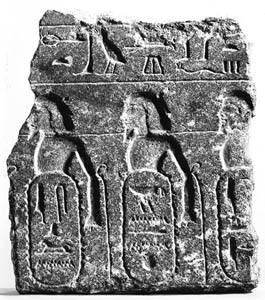
Biblical Archaeology 48 — The Berlin Fragment: “Israel” May be Attested to Earlier than the Merneptah Stele
Posted by Jason Dulle under Archaeology[4] Comments
I’ve been sitting on this report for several months now….
The Merneptah Stele, dated to between 1210 – 1205 BC, has long been thought to contain the earliest extra-biblical reference to “Israel.” However, there may be a reference to Israel in an artifact that is ~200 years older than Pharaoh Merneptah’s stele, but has been lying unnoticed in a museum storeroom for nearly 100 years.
University of Munich Hebrew scholar and Egyptologist, Manfred Görg, recently discovered a small granite slab in the storeroom of the Egyptian Museum of Berlin that he and a couple of colleagues argue contains a reference to Israel that predates the Merneptah Stele by ~200 years.[1]
The 18” x 15.5” fragment is believed to have been part of a pedestal for a statue. It contains two wholly preserved and one partially preserved Egyptian “name rings.” Pharaohs would often record their exploits by listing in rows the names of all the cities or peoples they conquered. The name of the city was written in a round-edged rectangle, and above this name ring was a pictorial representation of the people of that city – consisting of a head and upper torso.
February 27, 2012
I am known for posting regularly and responding to comments, but over the past two weeks I have only posted one new post and have not been able to respond to the many comments that have been coming in on the various posts. Where have I been? Working. Unfortunately, blogging doesn’t pay the bills, and my work schedule has been hectic. And when I say hectic, I mean the working-through-the-night kind of hectic. I’ve been living off of 3-4 hours of sleep for the past three weeks. Things have let up a little bit, so I’ll begin posting more regularly again, but I can’t guarantee I’ll always be able to respond to comments (and I won’t even attempt to catch up on the old ones).
February 20, 2012
Tied at the Hip: The Logical and Evidential Versions of the Problem of Evil
Posted by Jason Dulle under Apologetics, Problem of Evil[30] Comments
After the failure of the logical problem of evil (deductive argument) to demonstrate the impossibility of God’s existence given the presence of evil in the world, atheists have largely turned to the evidential problem of evil (inductive argument) to provide a probabilistic argument against the existence of God. Whereas the logical problem of evil argued that the mere existence of evil in the world proves God cannot exist, the evidential problem of evil argues that the amount of evil in the world is so great that it is highly improbable that a good God exists. Those who advance the evidential form of the argument claim that if the amount of evil in the world reaches some threshold, then it is no longer reasonable to believe that a good God exists—and of course, they believe the amount of evil in the world has reached this threshold. The argument could be stated as follows:
(1) The probability of God’s existence is commensurate to the amount of evil in the world.
(2) The probability of God’s existence declines as the amount of evil increases
(3) There is much more evil in the world than we would expect there to be if a good and all-powerful God existed
(4) Therefore, it is improbable that God exists.
February 10, 2012
Prayer is not the (Only) Answer for Doubt
Posted by Jason Dulle under Apologetics, Epistemology[4] Comments
Have you ever questioned God’s existence or some point of Christian theology, and when you reached out to someone for help you were greeted with, “You just need to pray about it”? Is this the proper response? No, and again I say no! This sort of response is typically not helpful, and leads many sincere people to eventually abandon the faith.
What if you said “I am hungry” and someone responded by saying “Go pray about it.” Would you be satisfied with that? No, because it is eating, not prayer, that is the proper solution to the problem at hand. So why is it that when someone says “I am doubting my faith” that we think “Go pray about it” is a sufficient response? Prayer is not the kind of thing to adequately address the problem at hand. The problem is an intellectual one, and thus it requires an intellectual solution.[1] Christian theology and apologetics provide an intellectual account and justification for the Christian faith. While prayer should always be encouraged and never be discouraged, in this case prayer is not the meat and potatoes of the solution.
February 8, 2012
9th Circuit Upholds Lower Court’s Ruling that Prop 8 is Unconstitutional
Posted by Jason Dulle under Apologetics, Politics, Same-sex Marriage[5] Comments
Yesterday, the 9th circuit federal court of appeals upheld District Judge Vaughn Walker’s August 2010 decision that California’s Proposition 8 is unconstitutional by a 2-1 vote. Prop 8 was a voter referendum to amend the CA constitution to declare that marriage is only valid between a man and a woman. While the CA Supreme Court ruled that the amendment is constitutional (when judged against the California Constitution), their decision was appealed and Judge Walker ruled that it violates the U.S. Constitution. The 9th circuit court agrees.
February 7, 2012
A 1st Century Manuscript Fragment of Mark?
Posted by Jason Dulle under Bible, Textual Criticism, Theology[4] Comments
That’s the claim Daniel Wallace made during his most recent debate with Bart Ehrman at UNC Chapel Hill. In his summary of the debate at Parchment and Pen, Wallace writes:
We have as many as eighteen second-century manuscripts (six of which were recently discovered and not yet catalogued) and a first-century manuscript of Mark’s Gospel! … Bart had explicitly said that our earliest copy of Mark was from c. 200 CE, but this is now incorrect. It’s from the first century. I mentioned these new manuscript finds and told the audience that a book will be published by E. J. Brill in about a year that gives all the data. … I noted that a world-class paleographer, whose qualifications are unimpeachable, was my source.”
Later he described the newly discovered manuscript as “just a small fragment.” Nevertheless, if this is a manuscript copy of Mark’s gospel, and if it can be reliably dated to the 1st century AD, this would be the greatest NT manuscript find to date, surpassing even p52 (a small portion of John’s Gospel, dated to ~125 AD)! We’ll have to wait and see.
UPDATE 2/16: Dr. Wallace has written specifically on this issue on the Dallas Theological Seminary website and added a tiny bit more information by saying “it was dated by one of the world’s leading paleographers. He said he was ‘certain’ that it was from the first century.” In the comments I have also quoted Dr. Ben Witherington III regarding the owner of the fragment, and a bit more detail about it. Witherington made it sound as if it is much more than a “small fragment.” I guess we’ll have to wait until next year to see how small is small.
February 6, 2012
Intelligent Design: Specification, not just complexity is necessary for design detection
Posted by Jason Dulle under Apologetics, Intelligent Design[25] Comments
There are many illegitimate critiques of Intelligent Design (the hypothesis that some features of the world are best explained in terms of an intelligent cause rather than undirected natural processes). One example is the charge often leveled against ID that it improperly uses probability statistics to infer design. For example, in a BBC documentary titled The War on Science, Ken Miller accused IDers of making the mistake of calculating probabilities after-the-fact, making the unlikely seem impossible:
One of the mathematical tricks employed by intelligent design involves taking the present day situation and calculating probabilities that the present would have appeared randomly from events in the past. And the best example I can give is to sit down with four friends, shuffle a deck of 52 cards, and deal them out and keep an exact record of the order in which the cards were dealt. We can then look back and say ‘my goodness, how improbable this is. We can play cards for the rest of our lives and we would never ever deal the cards out in this exact same fashion.’ You know what; that’s absolutely correct. Nonetheless, you dealt them out and nonetheless you got the hand that you did.
February 2, 2012
Scott Klusendorf Addresses Abortion Questions
Posted by Jason Dulle under Abortion, Apologetics, Bioethics[14] Comments
Scott Klusendorf is the best pro-life apologist out there. No one can say as much as Scott can say in as little space and as eloquently as he can. He wrote an essay for the Christian Research Journal addressing five questions often asked of pro-life advocates and the pro-life movement:
- Are pro-life advocates focused too narrowly on abortion? After all, informed voters consider many issues, not just one.
- Why don’t pro-life advocates care about social justice both here and in developing countries?
- Why don’t pro-lifers oppose war like they do abortion?
- Instead of passing laws against abortion, shouldn’t pro-life Christians focus on reducing its underlying causes?
- Should pastors challenge church members who support a political party sworn to protect elective abortion?
It’s worth checking out his answers. It is not a long piece, and he provides some great answers to ponder.