 Jesus’ foremost mission was the salvation of sinners, not social justice. While the marginalized and oppressed tended to be the most receptive to Jesus’ message, his message was for all people because all people need to be saved.
What about Jesus’ healing ministry? While Jesus surely had compassion on the sick, His miracles had a bigger purpose than just helping the destitute and needy. They were intended to reveal His identity and confirm His message.
Jesus never raised money for the poor or went on a campaign to liberate the oppressed. If those things could be done, great, but that was not Jesus’ mission, and it’s not the church’s mission either. Our primary mission is to preach the gospel and call sinners to repentance. If we can help their lot in life along the way, all the better, but we must keep the Great Commission the central mission of the church.
Greg Koukl of Stand to Reason recently wrote an article related to this topic. He debunks the idea the myth that Jesus was a social justice warrior championing the cause of the poor and oppressed. Check it out.
 When it comes to evangelism, some of the hardest people to work with are those who are apathetic toward spiritual things. They simply don’t care whether God exists. This is often a conversation stopper. If you want to press on a bit more, however, there are some tactics for doing so. I’ve offered some thoughts on this in the past (
 Check out my latest article, “
 People often misunderstand and misapply the term “hypocrite.” A hypocrite literally refers to an actor. They are pretenders. In the realm of morals, a hypocrite is someone who pretends to be moral. They tell you not to do something, but have no intention of following their own commands. They are people who do not think their own rules apply to them. They might pretend to keep these rules, but secretly they flout them.
 It seems to me that most Christians have chosen to ignore Jesus’ teaching on divorce and remarriage. I realize that the Bible’s teaching on divorce and remarriage is not crystal clear, and that even conservative Christians hold to a number of different interpretations of the Biblical teaching. That said, I think it’s abundantly clear that Jesus only permitted divorce and remarriage in a very narrow set of circumstances.
 I saw a car the other day with a bumper sticker that read “celebrate every color.” On the one hand, this is a fine message since it attempts to treat all people equally. However, I find the concept of “celebrating color” to be troubling. Why should we celebrate the color of our skin? Why don’t we celebrate every eye color? What about every hair color? Why just skin?
 I have long been concerned by the modern, therapeutic view of forgiveness. On this view, forgiveness is primarily about ridding oneself of anger toward those who have hurt us, and this can be done completely independent of the sinner. He does not need to repent, and he does not need to know we have forgiven him.
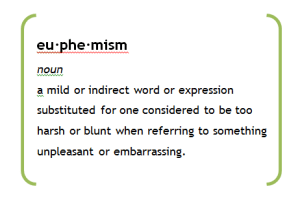 Euphemisms can be helpful. They allow us to talk about difficult topics in a sensitive way. They lessen the emotional impact. That’s why we have euphemisms for sex, excretions, and death.
 I baptize you with water for repentance, but he who is coming after me is mightier than I, whose sandals I am not worthy to carry. He will baptize you with the Holy Spirit and fire. (Matthew 3:11)
 Christians will often point out to atheists that if there is no God, then there is no objective meaning and purpose to life. Atheists will typically respond by saying that they create their own meaning in life. They find meaning in what they do, in family, etc. There are at least four problems with this, however.
 I am reminded of your sincere faith, a faith that dwelt first in your grandmother Lois and your mother Eunice and now, I am sure, dwells in you as well. 6 For this reason I remind you to fan into flame the gift of God, which is in you through the laying on of my hands, 7 for God gave us a spirit not of fear but of power and love and self-control. (2 Timothy 1:5-8, ESV)
 About a year ago, I
  If you think “God just wants me to be happy,” you are going to be very disappointed in your Christian life, and inclined toward sin and doubt. False expectations never end well.
 There’s no question that systemic racism existed in this country in the form of slavery, Jim Crow laws, and the like. However, all forms of systemic racism have been made illegal since the 1960s. Systemic racism does not exist in America today. That’s not to say there are no racists left in America. Surely there are, but they are few in number. To say systemic racism no longer exists in America is to say that racism is no longer embedded in society’s systems. There are no institutions or laws that are explicitly or implicitly based on racist ideology, nor policies that treat people differently based on their race.
 Based on my research, if you have been infected with COVID-19, there is no good reason for you to get vaccinated. Getting Covid provides you with a natural immunity to future reinfections that is thousands of times more effective than the immunity conferred by the vaccines. Also, the vaccines fare no better than natural immunity at preventing the transmission of Covid. Let me explain.
 Thinking to Believe