 More than 80 fragments of Nahum and Zechariah (not all have text written on them) were recently discovered in the Judean desert. These are the first Dead Sea Scrolls discovered in 60 years. Apparently, these fragments belong to a scroll of the Minor Prophets that was discovered in this same cave more than 60 years ago. That scroll, and these new fragments, are written in Greek rather than Hebrew. One of the interesting features of this scroll is that the name of God is written in paleo Hebrew, which is the ancient Hebrew script. Hopefully more scrolls will soon be discovered.
See:
 In
In  If you haven’t heard of the
  It’s common to hear theologians and apologists claim that Jesus’ self-designation, “son of man,” is a reference to the divine/exalted figure in Daniel 7:13-14. As such, Jesus’ use of “son of man” is a claim to deity. However, there are two problems with this conclusion. First, while Jesus referred to Himself as “son of man” many times, He only connected the term with Daniel 7:13-14 on one occasion (Mt 26:64-66; Mk 14:62-64; Lk 22:67-71). Is it reasonable to think that Jesus’ understanding of this phrase is based entirely on Daniel 7 when He only connected the phrase with Daniel 7 on one occasion at the end of His ministry? While I do not doubt that Jesus saw Himself as the son of man figure of Daniel 7, I do not think this exhausted His understanding or use of the phrase.
 There are differences of opinion regarding whether it is moral or beneficial for transgender people to undergo gender reassignment surgery. Regardless of where you land in that debate, everyone should be able to agree that it is unfair to allow “transgender women” (biological men who identify as women) to compete in women’s sports.
 When in a discussion, I tend to be quick to note my disagreement when someone says something I disagree with. I am prone to immediately launch into all the reasons I think they are wrong, followed by presenting and arguing for my own point of view. Unfortunately, this is not the best approach to resolving disagreement.
 The Left is always advocating that we raise taxes on the rich. It’s common to hear them say “the rich should pay their fair share in taxes.” I agree that people should pay their fair share in taxes, which is why I oppose raising taxes on the rich. In fact, I propose that we lower taxes on the rich and raise taxes on the poor (by which I simply mean the “non-rich”). Why? It’s because the rich already pay more than their fair share while the poor pay less than their fair share. As of 2017, the top 1% U.S. income earners made 21% of the total income, but pay 38.5% of all federal income taxes. If they were paying their fair share, they would be paying 21% of all taxes, not 38.5%. In fact, the top 1% pay more in taxes than the bottom 90% combined (29.9%). Even if you widen the net to the top 50% of income earners, this group pays 96.7% of all taxes. That means the bottom 50% of income earners only pay 3% of federal taxes. While the top 1% pay an average of 26.8% of their income in taxes, the bottom 50% only pays an average of 4% (6x less).
 Why doesn’t God give people a second chance to be saved after death (Heb 9:27)? Surely those who go to hell would want to repent once they are faced with the consequences of their sin, right? Wrong. This idea underestimates these people’s disposition toward God. They know God exists (Ps 19:1-4; Rom 1:18-32; 2:12-16), but they hate Him and refuse to acknowledge Him by repenting of their sins (Ps 83:2; Jn 3:20; 7:7; 15:18,23-24; Rom 1:30; Rev 9:20; 16:9,11). They reject His moral authority over their lives. While they do not like their punishment, they don’t want the alternative either. They don’t love God, and they don’t want to be with Him for eternity. It’s not so much that God will not give them a second chance to repent as it is that they would not take Him up on His offer if He were to give it.
 We are saved by faith, not works, but the faith that saves is a faith that works. True saving faith will produce good works. Faith, not works, is the causal condition for salvation, but good works are the necessary effect of our saving faith. That doesn’t mean we will be perfect, but it does mean we will be moving toward perfection via the process of sanctification.
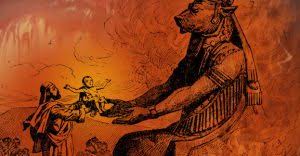 Abortion is often compared to the practice of child sacrifice practiced by many ancient cultures, including those in OT times. It is not a 1:1 comparison, of course. Those who get abortions are not doing so for religious reasons, and the age of the children are different. However, in both cases, human beings are choosing to kill their own children. God hates murder, whatever the reason or the age of the victim.
 Our biggest temptation as humans is works righteousness – thinking that we can earn our salvation by own goodness. Ask the average nominal Christian in America how he knows he is saved and you’re likely to hear, “Well, I’m a pretty good person.” Even those who recognize that they are saved by grace alone often feel the temptation to believe they are “kept,” at least in part, by their good works. While we are certainly saved for good works (Eph 2:8-10; Tit 2:11-12), good works cannot save us or keep us saved. Our trust in Jesus alone saves us. Faith causes salvation – good works are the effect.
 Sometimes we portray Jesus as providing us with a ladder to bridge the chasm between our sinful selves and a holy God. Jesus made a way for us to reach God. This is inaccurate. Jesus didn’t just provide us with a ladder and tell us to climb, but Jesus provided the ladder and climbs it for us. We get to the top – not by climbing it ourselves – but by riding on the back of Jesus.
 For a number of years now, churches have latched on to the “leadership training” fad. The idea is that everyone is a leader, and needs to be trained as such to be more effective in the kingdom. Really? Is everyone a chief? If so, where are the Indians? Those who claim everyone is a leader have to have a pretty thin definition of leader. Yes, everyone has influence in someone else’s life at some point, but that does not make them a leader or require that they undergo leadership training.
 Thinking to Believe