 If you haven’t heard of the story regarding the dad jailed for calling his trans-son “daughter” and using female pronouns, you need to. He was arrested for “family violence.” While this happened in Canada, given the trajectory in the U.S., it won’t be long before this kind of thing happens here as well. Indeed, we are on the precipice of this happening here already.
March 26, 2021
Father jailed for calling his trans-son his “daughter”
Posted by Jason Dulle under Apologetics, Political Incorrectness, Politics, Transgender[4] Comments
March 25, 2021
Equality and equity do not mean the same thing. Equality is everyone being treated equal and getting what they deserve. Equity means fairness, but the way the political Left understands equity is anything but fair. They see equity as ensuring the same outcome whether you deserve it or not, and largely based on comparing groups to groups rather than individuals to individuals. This sort of equity is not achieved by treating everyone equally, but by treating some groups unequally so that the results are the same for all groups. If group A makes more money than group B, then policies are instituted that hurt group A but benefit group B so that the two groups will have the same outcome. Unfairness in the name of fairness. Don’t fall for this verbal deception. That’s not equity. Support equality of opportunity, not equality of outcome.
March 23, 2021
 It’s common to hear theologians and apologists claim that Jesus’ self-designation, “son of man,” is a reference to the divine/exalted figure in Daniel 7:13-14. As such, Jesus’ use of “son of man” is a claim to deity. However, there are two problems with this conclusion. First, while Jesus referred to Himself as “son of man” many times, He only connected the term with Daniel 7:13-14 on one occasion (Mt 26:64-66; Mk 14:62-64; Lk 22:67-71). Is it reasonable to think that Jesus’ understanding of this phrase is based entirely on Daniel 7 when He only connected the phrase with Daniel 7 on one occasion at the end of His ministry? While I do not doubt that Jesus saw Himself as the son of man figure of Daniel 7, I do not think this exhausted His understanding or use of the phrase.
March 19, 2021
Why can’t we all agree that it’s absurd to allow biological men compete in women’s sports
Posted by Jason Dulle under Apologetics, Transgender[2] Comments
 There are differences of opinion regarding whether it is moral or beneficial for transgender people to undergo gender reassignment surgery. Regardless of where you land in that debate, everyone should be able to agree that it is unfair to allow “transgender women” (biological men who identify as women) to compete in women’s sports.
This is not about equality, but fairness. Biological males have clear physical advantages over biological females, guaranteeing that transgender women will beat all or most biological women in sports. That is why we have always separated sports by sex. Allowing transgender women to compete in women’s sports is not fair to biological women. They practice and train for years to be the best among women, only to be beaten by a biological male.
March 16, 2021
Make them justify before you falsify
Posted by Jason Dulle under Apologetics, Tactics, Thinking[5] Comments
 When in a discussion, I tend to be quick to note my disagreement when someone says something I disagree with. I am prone to immediately launch into all the reasons I think they are wrong, followed by presenting and arguing for my own point of view. Unfortunately, this is not the best approach to resolving disagreement.
The mantra I am trying to live by is “make them justify before you falsify.” What does this mean? Before you ever attempt to falsify someone’s belief or statement, ask them why they think it is true. Why do they believe what they believe? What reasons do they have? The burden of proof is always on the person making the claim. It’s not our job to show why they are wrong, but their job to demonstrate that they are right.
If you pause a moment to make them justify their claim, you’ll often find that they have little-to-no justification, or that their reasons are quite bad. Once they realize that they have no (or poor) justification, they will likely be more open to your critique of their view as well as your own view. So the next time you are tempted to voice your disagreement, make them justify before you falsify.
March 12, 2021
“The rich should pay their fair share in taxes”
Posted by Jason Dulle under Uncategorized[7] Comments
 The Left is always advocating that we raise taxes on the rich. It’s common to hear them say “the rich should pay their fair share in taxes.” I agree that people should pay their fair share in taxes, which is why I oppose raising taxes on the rich. In fact, I propose that we lower taxes on the rich and raise taxes on the poor (by which I simply mean the “non-rich”). Why? It’s because the rich already pay more than their fair share while the poor pay less than their fair share. As of 2017, the top 1% U.S. income earners made 21% of the total income, but pay 38.5% of all federal income taxes. If they were paying their fair share, they would be paying 21% of all taxes, not 38.5%. In fact, the top 1% pay more in taxes than the bottom 90% combined (29.9%). Even if you widen the net to the top 50% of income earners, this group pays 96.7% of all taxes. That means the bottom 50% of income earners only pay 3% of federal taxes. While the top 1% pay an average of 26.8% of their income in taxes, the bottom 50% only pays an average of 4% (6x less).[1] Does this sound fair to you? So on what grounds can one legitimately claim that the rich are not paying their fair share, and need to be taxed even more?
February 22, 2021
Why God doesn’t give the damned a second chance to be saved
Posted by Jason Dulle under Hell, Sin, Theology1 Comment
 Why doesn’t God give people a second chance to be saved after death (Heb 9:27)? Surely those who go to hell would want to repent once they are faced with the consequences of their sin, right? Wrong. This idea underestimates these people’s disposition toward God. They know God exists (Ps 19:1-4; Rom 1:18-32; 2:12-16), but they hate Him and refuse to acknowledge Him by repenting of their sins (Ps 83:2; Jn 3:20; 7:7; 15:18,23-24; Rom 1:30; Rev 9:20; 16:9,11). They reject His moral authority over their lives. While they do not like their punishment, they don’t want the alternative either. They don’t love God, and they don’t want to be with Him for eternity. It’s not so much that God will not give them a second chance to repent as it is that they would not take Him up on His offer if He were to give it.
February 19, 2021
Pro-life: No religion needed
Posted by Jason Dulle under Abortion, Apologetics, Bioethics[37] Comments
If you think the only argument against abortion is a religious argument, please examine the pro-life case more closely. While a religious argument can be made, it is not necessary. The pro-life argument stands or falls on biological facts plus philosophical/moral reasoning. It’s very simple:
(1) It’s morally wrong to kill innocent human beings without proper justification (the philosophical/moral premise)
(2) The science of embryology demonstrates that a new, distinct human being comes into existence at conception (the scientific premise)
(3) It follows from (1) and (2) that abortion kills an innocent human being
(4) Therefore, abortion is morally wrong
If you are going to argue for abortion, you’ll need to falsify one of the first two premises above. Will you deny the moral truth that it’s wrong to kill innocent human beings, or will you deny the scientific facts of embryology?
February 18, 2021
Eternal punishment for a finite number of sins?
Posted by Jason Dulle under Hell, Theology[12] Comments

Many people (non-Christians and Christians alike) find it morally outrageous that God would consign people to an eternity in hell to pay for a finite number of sins committed here on Earth. As a result, some people reject Christianity, some deny that hell is eternal, and others choose to live with the theological tension. None of this is necessary, however, because this understanding of hell is based on false assumptions. It falsely assumes that the purpose of hell is only to pay for sins committed prior to death, which, in turn, falsely assumes that people stop sinning in hell. Neither is true.
Yes, hell is a place where people will be punished for their sins, but it is also a place where the sinners who are being punished for their sins will go on sinning for eternity. They sin on Earth and in heaven. Think about it. Does anyone believe that those in hell suddenly become good people? Do we really think that they undergo complete sanctification upon entering hell? Of course not. They will continue to sin against God for eternity. They will continue in their moral rebellion and rejection of God. And that is why they will continue to be punished by God for eternity.
February 12, 2021
Faith that works
Posted by Jason Dulle under Hamartiology, Holiness, Soteriology, Theology[11] Comments
 We are saved by faith, not works, but the faith that saves is a faith that works. True saving faith will produce good works. Faith, not works, is the causal condition for salvation, but good works are the necessary effect of our saving faith. That doesn’t mean we will be perfect, but it does mean we will be moving toward perfection via the process of sanctification.
February 11, 2021
Abortion, Molech, and Passive Sin
Posted by Jason Dulle under Abortion, Apologetics, Bioethics[7] Comments
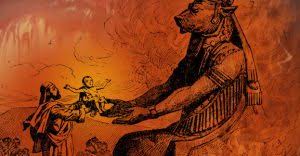 Abortion is often compared to the practice of child sacrifice practiced by many ancient cultures, including those in OT times. It is not a 1:1 comparison, of course. Those who get abortions are not doing so for religious reasons, and the age of the children are different. However, in both cases, human beings are choosing to kill their own children. God hates murder, whatever the reason or the age of the victim.
I find it interesting, then, that God not only condemned those who committed child sacrifice, but also those who stood by silently and did nothing to those who sacrificed their children. Consider Leviticus 20:1-5. God begins with a condemnation of those who commit child sacrifice:
February 10, 2021
Tempted to works righteousness
Posted by Jason Dulle under Faith, Hamartiology, Holiness, Justification, Sin, Soteriology, Theology[444] Comments
 Our biggest temptation as humans is works righteousness – thinking that we can earn our salvation by own goodness. Ask the average nominal Christian in America how he knows he is saved and you’re likely to hear, “Well, I’m a pretty good person.” Even those who recognize that they are saved by grace alone often feel the temptation to believe they are “kept,” at least in part, by their good works. While we are certainly saved for good works (Eph 2:8-10; Tit 2:11-12), good works cannot save us or keep us saved. Our trust in Jesus alone saves us. Faith causes salvation – good works are the effect.
We could never do enough good works to be accepted by God because, in God’s economy, good works cannot cancel out evil works. And it’s our evil works that are the problem. They are an affront to God’s holiness. If we are to have a relationship with a holy God, our evil works have to be dealt with. The problem is that mankind has no ability to atone for his evil works. Only God can do that. And He did. He became a man and paid the penalty for our sin (death) on the cross. The sinless man died in the place of sinful man. The way we access the atonement God provided for us is by trusting in Jesus and what He did for us on the cross. Since God’s acceptance of us is based entirely on Jesus’ work rather than our own, God’s continued acceptance of us is also based on Jesus’ work rather than our own (Rom 5:8-11).
February 9, 2021
Jesus is more than a ladder
Posted by Jason Dulle under Justification, Soteriology, Theology[3] Comments
 Sometimes we portray Jesus as providing us with a ladder to bridge the chasm between our sinful selves and a holy God. Jesus made a way for us to reach God. This is inaccurate. Jesus didn’t just provide us with a ladder and tell us to climb, but Jesus provided the ladder and climbs it for us. We get to the top – not by climbing it ourselves – but by riding on the back of Jesus.
February 5, 2021
Don’t play the victim card
Posted by Jason Dulle under Odds & Ends, Political Incorrectness[2] Comments
The victim card is a hot card these days. And when there’s not enough opportunities to be a real victim, people literally fake victimhood (think of the multitude of “hate crime” hoaxes). Why would anyone want to be a victim? Because of identity politics. Victimhood = power and prestige in today’s upside-down world.
None of this is to deny that there are real victims. However, there’s a difference between having been a victim to some wrong and maintaining a victim mindset. The victim card is not an acknowledgement of past wrongs, but often an excuse for one’s present situation. You are not a victim. That may have been one of your experiences in life, but it is not your identity.
To those who think of themselves as a victim, I ask you one question: Who is in control of your life? Is it you, or the person(s)/situation who/that victimized you? Don’t let that one person or one event define your life. No one can control your life unless you let them. So don’t let them. You are not a victim to anybody or anything. You are a victor if you choose to be.
February 5, 2021
When discussing Christianity with a non-Christian, it’s not uncommon for them to dismiss the call to discipleship by saying, “I’ve tried religion and it didn’t work for me.” There are a number of questions you could ask when hearing such a statement.
First, “What religion(s) did you try?” There are many different religions, and most are as different as night and day.
January 29, 2021
If I hear one more message on leadership training…
Posted by Jason Dulle under Miscellaneous, Theology[10] Comments
 For a number of years now, churches have latched on to the “leadership training” fad. The idea is that everyone is a leader, and needs to be trained as such to be more effective in the kingdom. Really? Is everyone a chief? If so, where are the Indians? Those who claim everyone is a leader have to have a pretty thin definition of leader. Yes, everyone has influence in someone else’s life at some point, but that does not make them a leader or require that they undergo leadership training.
Despite the fact that I don’t think everyone is a leader, I wouldn’t be bothered by all of this leadership training if churches were also focused on theological training. In my experience, however, people being trained in leadership are getting virtually no theological training at all. People well-versed in leadership couldn’t exegete their way out of a paper bag or tell you the first thing about the Bible’s teaching on justification. Let’s get first things first. Theological training is a necessity for every Christian. Leadership training is a luxury.
January 27, 2021
Prayer and Biblical interpretation
Posted by Jason Dulle under Bible, Hermeneutics, TheologyLeave a Comment
I often hear people preface their wayward theological musings with, “I really prayed about this and did a lot of study.” If they are simply making the point that they did not come to their conclusions rashly, fine, but this sort of statement is often used as a justification for their theological conclusions. They are appealing to their prayer and study as reasons to accept their beliefs as true. This is mistaken. Prayer and study do not guarantee that one will come to the right conclusions. This should be evident from the fact that many people have given themselves over to much prayer and study regarding a particular issue, only to come to different conclusions. Prayer and study do not guarantee that you will come to the right conclusion, and surely they are not good reasons for others to trust your conclusions. All that matters are the reasons you offer for your conclusions. If your reasons are good, then your conclusion should be trusted. If your reasons are bad, then your conclusions should not be trusted. The same goes for your facts and presuppositions. Your conclusion will only be as good as the facts you considered and the presuppositions you bring to the question. I’m glad you prayed and studied, but I care more about your reasons than your investment and sincerity.
December 22, 2020
 Sometimes we think it’s only those who are poor or hurting who want or need God. We are reluctant to share the gospel with those who are wealthy and successful, and have friends and influence. But these people can be quite open to the gospel precisely because they are wealthy and successful, and have friends and influence.
They were broken and unhappy before they obtained these things, and they believed that money, fame, and success would fix their brokenness and fulfill their deepest longings. When money, fame, and success didn’t bring them happiness, they despair all the more. Now, they are acutely aware of just how empty life is, and how nothing satisfies. That’s why they are so open to the gospel. They don’t have anything else to try. On the other hand, those who are poor, not famous, not successful, and not influential are still under the delusion that wealth and fame can make them happy, and thus they can be harder to reach than the wealthy and famous. This about this the next time you are reluctant to share the gospel with someone because you think they don’t see the need for God.
December 14, 2020
One false prophecy = one false prophet
Posted by Jason Dulle under Spiritual gifts, Theology, Voice of God[84] Comments
 Many so-called prophets had prophesied that Trump would win re-election, including Kris Vallotton, Jeremiah Johnson, Pat Robertson, Curt Landry, Tomi Arayomi, Kat Kerr, Denise Goulet, Charlie Shamp, Albert Milton, Taribo West, Kevin Zadai, and many more (references are in the comments). President Trump’s legal challenges to the election results have failed and the Electoral College has voted for Joe Biden to be the next president, so it should be abundantly clear at this point that Trump is not going to serve another four years.
Will those who follow the aforementioned prophets shrug off this as just an unfortunate example of how “everyone misses it from time to time,” or will they recognize these people for what they are: false prophets?
November 25, 2020
You can always tell when someone believes something based on their emotions/will rather than their reason: They resort to name-calling, yelling, violence, shame, intimidation. They want to silence the opposition rather than respond to them. I heard it said that you know someone doesn’t have a good argument when they resort to hitting people with blunt objects to make their case.
Many Christians would disavow such things, but they have another way of responding to challenges to their ill-founded beliefs. When they don’t have good reasons to support their claims or to challenge your arguments, they trump you with spirituality. They will say the Holy Spirit told them that X is true, or that the only reason you believe X is because you are not spiritual. Don’t fall for the bait by shifting the focus to your own spirituality. Shift the focus back to the argument by responding, “Ok, so I’m carnal. Can you tell this carnal brother of yours why I should believe you are right (or conversely, why I should believe I am wrong)?”

 Thinking to Believe