Down SyndromeIt’s commonly said that 90% of all unborn babies with Down Syndrome are aborted.  This statistic is offered by both conservatives and liberals alike.  Fortunately, it’s based on a misunderstanding of the data.  Studies have shown that approximately 90% of women who undergo an amniocentesis diagnostic test and are told that their baby has Down Syndrome end up aborting the baby (which is not surprising considering the fact that this is the second test for the disease, is invasive, and carries a risk of killing the baby.  It stands to reason that women willing to undergo the procedure do so because they want to be sure that their child has Down Syndrome before they kill him/her).  In other words, the people who undergo amniocentesis are more likely to abort a baby with Down Syndrome than those who do not, but only ~2% of pregnant women undergo amniocentesis.  When you consider all women pregnant with a baby suffering from Down Syndrome, the abortion rate is estimated to be somewhere between 1/3 to 1/2.  That is still way too much, but not nearly as bad as 90%.

Check out this video from Stand to Reason demonstrating why abortion is unjust discrimination against the unborn.

At least that’s the idea behind some new research on the effects of belief in God on the brain. Apparently, people suppress the areas of the brain used for analytical thinking and engage those parts of the brain used for empathy in order to believe in God.  The clear message of these research “findings” is that you have to stop thinking in order to believe in God.  Belief in God is about how you feel, not about what you think.

I have not read the actual research, and probably couldn’t make much sense of it even if I had.  But I don’t need to review the research in order to know that this research is irrelevant to the question of whether God exists.  First, it commits a logical fallacy known as the genetic fallacy.  This fallacy is committed any time one attempts to invalidate the truth of some X because of the origin of X.  Since belief in God has its origin in our feelings rather than our thinking (the origin of X), God (X) does not exist.  He’s just a product of our personal feelings.

(more…)

empty_tombThe resurrection of Jesus Christ from the dead was the central message of the early church and the basis of Christian hope.  But why should we believe that a man was raised from the dead 2000 years ago when we were not there to witness it, and when our uniform experience says that dead people always stay dead?  While many people think the resurrection of Jesus is something you either choose to believe or choose to reject based on your personal religious tastes, the fact of the matter is that there are good, objective, historical reasons to believe that Jesus rose from the dead.

(more…)

God exists because evil existsMany think that the existence of evil disproves God’s existence. Nothing could be further from the truth. Evil is a real problem we must wrestle with, but it argues for God’s existence, not against it.

For evil to be a problem, evil has to be real – not just an expression of human desires, preferences, or opinions.  Evil is the absence of good, so for evil to be real, an objective standard of goodness must exist that transcends human beings.

What is the source for that standard?  God.  He is the Good, and we recognize good because we are made in His image.

Besides, denying God’s existence because evil exists does nothing to solve the problem of evil.  Only if God exists can we have hope that evil will be overcome and those who commit evil face true justice for their moral crimes.

If God is good, why is there evil? Because love requires freedom, and freedom entails choosing either the good or the evil. God was good to give us free will. We are responsible for abusing this good thing, not God, and yet God has taken it on Himself to fix the problem we created. God is not just observing the pain and suffering we experience from evil, but became one of us and experienced it Himself so that He can empathize with us and ultimately overcome evil for us.

A 2010 study by the Center for Research on Gender & Sexuality at San Francisco State University examined the level of monogamy (or lack thereof) in male homosexual relationships in the San Francisco Bay Area.  Based on a study of 566 gay couples, lead researcher Colleen Hoff found that 47% had an open relationship, 45% were monogamous, and 8% did not agree on what they were. This is congruent with a number of other studies of male homosexuality. In the same way it is a mistake to think that all male homosexuals are promiscuous, it’s a mistake to think they all embrace the monogamous ideal of marriage.

See also:

Male homosexual relationships often lack the monogamous ideal

Same-sex marriage will likely redefine our concept of marriage

HT: Winterey Knight

From Bloomberg News:

Abortion access in the U.S. has been vanishing at the fastest annual pace on record, propelled by Republican state lawmakers’ push to legislate the industry out of existence. Since 2011, at least 162 abortion providers have shut or stopped offering the procedure, while just 21 opened.

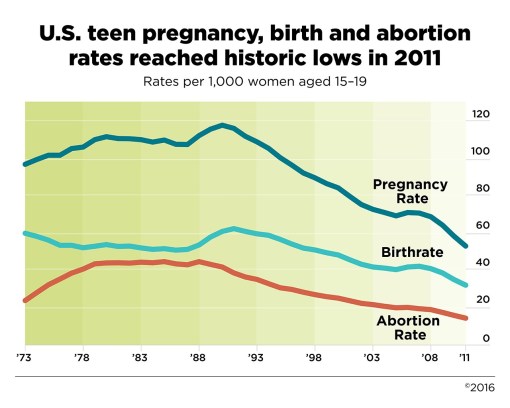
Typically defined by medical researchers as facilities that perform 400 or more abortions per year, the ranks peaked in the late 1980s at 705, according to the Guttmacher Institute, a New York-based reproductive-health research organization. By 2011, the most recent year for which Guttmacher has data, that number had fallen to 553.

Read the rest at http://www.bloomberg.com/news/articles/2016-02-24/abortion-clinics-are-closing-at-a-record-pace.

Story of ChristianityMuch of the Bible is written in narrative form.  It tells a story – a true story, but a story nonetheless.  There is a lot of information in the Bible to digest, and it’s easy to get lost in the details and miss the big picture.  So how does one put it all together?  What is the essence of the Biblical story?  What is the basic story line from Genesis to Revelation?  Various attempts have been to condense the major themes and events in the Bible into a coherent, terse story line.  Here is my attempt to arrange the puzzle pieces into a clear picture, such as it is.  I hope it will tie together some loose ends that may exist in your mind and offer you a bird’s-eye view of the greatest story ever told: (more…)

Is Atheism Simply a Lack of Belief in GodThere’s a concerted effort by a lot of atheists to redefine “atheist” from the metaphysical claim that God does not exist to a personal claim about one’s psychological state, namely that they lack a belief in God. It’s a strategic move to remove any burden of proof for their position (God does not exist). This redefinition has some interesting implications:

  1. Atheism and theism could both be true at the same time.
  2. Atheism is just an autobiographical assessment and tells us nothing meaningful about whether God exists or not.
  3. Atheism cannot be true or false.
  4. People who have evidence to believe in God are atheists.
  5. Babies and cats also qualify as atheists.

Lacking a belief in God makes one an agnostic, not an atheist. Besides, while most of these atheists lack belief in God, they do not lack beliefs about God. They think he (probably) doesn’t exist, and that belief must be justified.

Finally, something has been done about the Episcopalian Church’s flagrant acceptance of homosexuality and same-sex marriage in defiance of Church of England’s teaching. The pessimist in me thinks this disciplinary action is not enough, is just delaying the inevitable split of the church, and was probably forced upon the Church of England’s native leaders by its conservative bodies abroad.  I would love to hear the thoughts of anyone living in England or part of the Episcopalian Church.

dogmaticIf you can’t point to at least one verse/fact that runs contrary to your doctrinal position that makes you at least a little bit uncomfortable, or if you can’t cite at least one good argument against your position you might just be a bit too dogmatic and probably haven’t read widely enough. While I think we can be confident in what we believe, very few matters of intellectual dispute are so cut and dry that there aren’t decent arguments for contrary positions. If you are not aware of those other arguments, and if you are not made at least a bit uncomfortable by any of them, this should be a sign that your confidence in your doctrinal position might be a bit premature.

(more…)

Cohabit - Not MarriageThe American College of Pediatricians explains why cohabitation is bad for society in just about every way imaginable.  And yet cohabitation continues to rise as the folk wisdom says it will increase one’s chances of marital success.  Nothing could be further from the truth.  The most happiness does not come from receiving the benefits of marriage (sex, playing house) without actual marriage, but from marriage itself.


See also: The sociology of cohabitation: “Shacking up” isn’t such a good idea after all

openFor those who doubt that gay men in committed relationships are much more promiscuous than their heterosexual counterparts, read this article at The Daily Beast.

Obviously not every gay couple has an open relationship, but the ideal of monogamy is not present in gay relationships to the same degree it is in heterosexual relationships.

This makes sense. Most men are not naturally monogamous. They would prefer to have more than one sexual partner at a time. The reason most men resist this desire is because the stability of their preferred relationship depends on it (i.e. their favored woman demands it as a prerequisite to continue the relationship) and/or because of their religious beliefs about the sanctity of sex and marriage. Many gay men do not subscribe to traditional moral/religious sexual ethics (which not only proscribe sex outside of marriage, but also proscribe gay sex), and there is no female in the relationship to demand monogamy. In other words, the traditional restraints for monogamy are removed in gay, male relationships. It’s not surprising, then, that gay male relationships (unlike gay female relationships and heterosexual relationships) are often not monogamous, but include outside sexual liaisons.

vote pro-lifeWhenever the subject of abortion and politics comes up, inevitably well-meaning but uninformed people will say pro-life politicians (particularly Republicans) aren’t really doing anything to prevent abortion – that it’s just a position they pay lip-service to in order to court the vote of conservative Christians; therefore, it doesn’t really matter who you vote for.  This simply isn’t true.  Just ask the pro-abortion Guttmacher Institute.  In their latest press release they write:

Including the 57 abortion restrictions enacted in 2015, states have adopted 288 abortion restrictions just since the 2010 midterm elections swept abortion opponents into power in state capitals across the country. To put that number in context, states adopted nearly as many abortion restrictions during the last five years as during the entire previous 15 years. … The 288 new restrictions enacted since 2010 include a broad range of approaches, from banning some abortions to putting restrictions on the providers allowed to perform the procedures to limiting insurance coverage.

Clearly how one votes can make a difference for the unborn. While the current political situation does not allow for politicians to outlaw abortion entirely, they can and do pass legislation to reduce the number of abortions by providing more information to women and making it more difficult to obtain abortions. How you vote can and does translate into saving the lives of innocent children, and saving women a lifetime of guilt for having murdered their own babies.


UPDATE: The Guttmacher Institute released a report declaring that more than a quarter of all anti-abortion laws passed since Roe have been passed in the last five years (288 of 1,074).


See also: “Pro-life Republican politicians aren’t just paying lip-service to the pro-life cause

OmnipotentSome people claim the existence of God cannot be falsified.  As I have argued elsewhere, this is not true. One way to falsify God’s existence is to show that the concept of God is logically incoherent. This can be done by demonstrating that two or more supposed divine attributes are logically incompatible. For example, it has been argued that omnipotence and omnibenevolence are logically incompatible.

The objection

The argument is set forth along these lines: Omnipotence entails the power to actualize any state of affairs that is logically possible to actualize. There is nothing logically incoherent about an omnipotent being committing evil, so omnipotence must include the power to actualize a world in which the omnipotent being commits evil. As an omnibenevolent being, however, God is incapable of committing evil.  Therefore, God cannot be omnipotent.  While a being can be either omnibenevolent or omnipotent, no being can be both omnibenevolent and omnipotent.  Since the theistic concept of God entails both, the God of theism cannot exist.

Areas of agreement

How might the theist respond to this objection?  Let us start with some points of agreement.  First, we agree that God must be both omnipotent and omnibenevolent.  Theistic philosophers have long held that the concept of God is that of the greatest conceivable being (GCB).  God is a being of which a greater cannot be conceived.  If we can conceive of some being Y who is greater than the being we call God, then being Y is the true God. Since it is greater to be all-powerful than partially powerful, the GCB must possess the property of being all-powerful.  Likewise, since it is greater to be all-good than partially good, the GCB must possess the property of being all-good.

(more…)

William Lane Craig’s ministry, Reasonable Faith, has released another excellent video illustrating a major argument for God’s existence.  This time it’s the argument from contingency.  Of the four released thus far (kalam, moral, cosmic fine-tuning), this is probably the most difficult to follow, but it also has the best graphics.  Take a look:

Two cases out of the United Kingdom are causing great concern for the freedom of speech.

Earlier this year a Christian street preacher in England, Mike Overd, was convicted for quoting Leviticus 20:13 as a condemnation against homosexuality after a homosexual complained to police. The judge reasoned that since Leviticus 20 doesn’t just condemn homosexuality, but prescribes the death penalty for it, the preacher was inciting violence against homosexuals (even though Overd claims he did not quote the portion of the text calling for the death penalty). He even added that he would have avoided a fine had he quoted from Leviticus 18:22 instead since there is no mention of the death penalty for homosexuality in that passage.

(more…)

It was announced last week that another King Hezekiah bulla has been found (initially discovered in 2009).  This is a small clay seal (13×12 millimeters) used by Hezekiah to seal and authenticate a document. It was molded around the strings that tied the document shut. In fact, we can still see the impression from the fibers on this bulla.

We already had eight other bullae bearing King Hezekiah’s name, but they were unprovenanced. This new bulla was uncovered during an official excavation at the Temple Mount in Jerusalem by Dr. Eliat Mazar. It reads, “Belonging to Hezekiah, (son of) Ahaz, king of Judah.”

There’s a nice video on the find here.

The discovery of this bulla should remind us again that the Bible is not a book of fairy tales. It is written as history, and archaeological finds such as this prove that it is based on real historical people and real historical events.

The power to tax is the power to enslave. That’s not to say taxation itself is immoral. All of us can agree to a reasonable amount of taxes to pay for a functional government and basic social resources like funding the military, paving roads, and the like. But the bigger the government gets, the more taxes it needs, and the more money it takes. If the government taxed an individual 100% of their income, they will have effectively enslaved them because they are working entirely for the government and not benefiting from their own work. If the individual was allowed to keep 10% of their earnings, they are little better than a slave. It’s just a matter of degree. As this entitlement culture demands more and more, the government will continue to take more and more in taxes, enslaving us degree by degree. If you want freedom, keep our government small.